
Thermal Imaging
Thermal Imaging Surveysin Leeds: Find the Hot SpotBefore It Finds You
Thermographic surveys of live distribution boards, switchgear and machinery that identify loose terminations, overloaded circuits and failing components under load, with no shutdown, no downtime and a report you can act on the same week.
No shutdown required · 17 years in the trade · Remedials completed in-house
- No shutdown
- Surveyed live, under normal load
- 17 years
- Commercial and industrial experience
- CHAS
- Accredited for health and safety
- In-house
- Repairs and re-survey by the same team
- 4.9 / 5
- From 105 Google reviews
Service overview
Thermal imaging
What it is
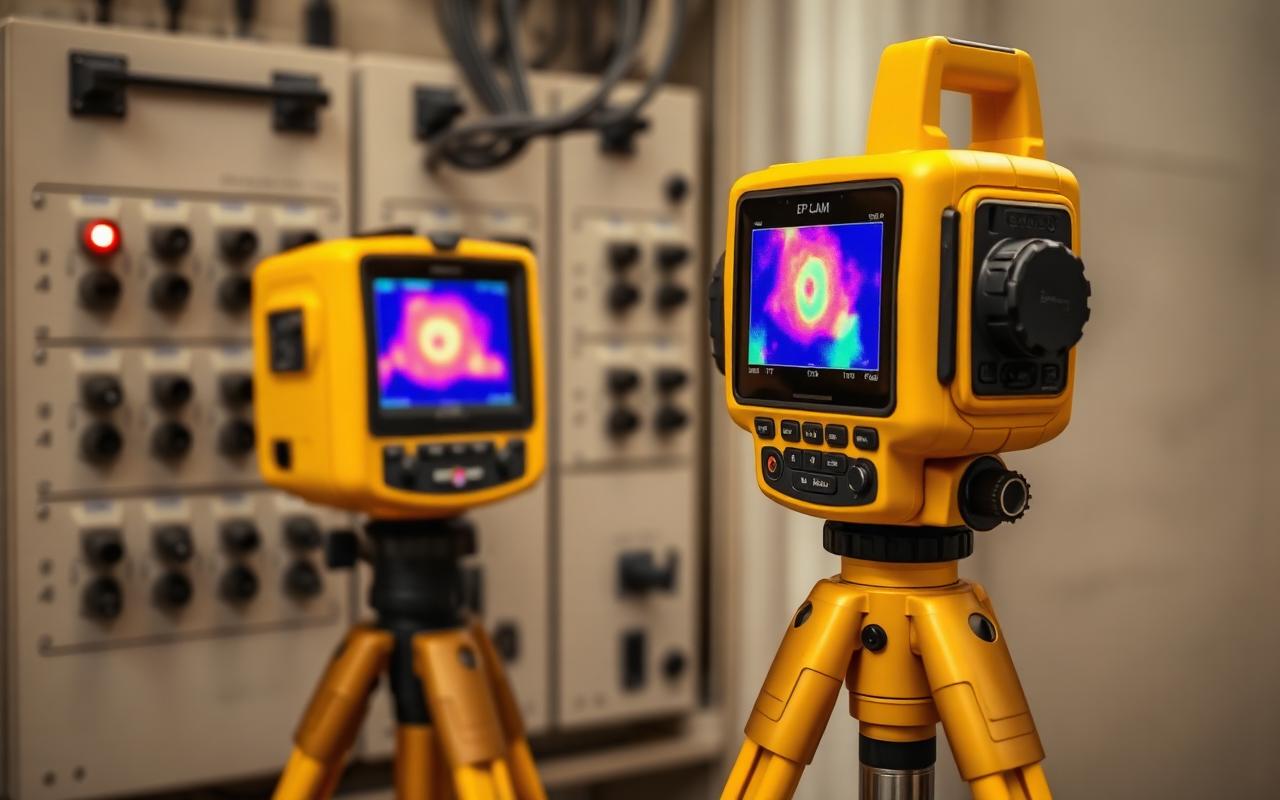
A thermal imaging survey uses an infrared camera to measure the surface temperature of electrical equipment while it is energised and carrying its normal load. Electrical faults almost always generate heat before they generate failure, so temperature is the earliest reliable signal that something is going wrong inside an enclosure.
Typical targets are incoming supplies and main switchgear, distribution and sub-distribution boards, busbars and connections, contactors and starters, control panels, motor terminations, drives and capacitor banks, plus machinery bearings and mechanical assemblies where those matter to production.
The output is a report pairing thermal and visible images of every anomaly with the measured temperature rise, the affected component, the likely cause and a priority rating, so you know what needs isolating this week and what can wait for the next planned shutdown.
Who it is for
Manufacturing and engineering sites where an unplanned electrical failure costs a shift rather than a fuse.
Facilities and estates managers responsible for large distribution systems, data areas or critical building services.
Commercial landlords and property managers wanting condition evidence between fixed wire testing cycles.
Insurers' requirements: sites where a periodic thermographic survey is expected as part of cover or risk management.
Anyone with a board that has previously overheated, a history of nuisance tripping, or equipment they simply cannot afford to lose.
When you need it
Annually, as part of a planned maintenance regime, with the survey run under representative load.
Between fixed wire testing cycles, to catch developing faults without waiting three or five years.
Before peak season, a heavy production run or a period where downtime is unaffordable.
After significant load changes, new machinery installations or distribution alterations.
Immediately, where you can smell hot plastic, see discolouration on a board, or have had repeated unexplained tripping.
Why it matters
Most catastrophic electrical failures start as a resistance problem invisible to the eye. A termination works loose through thermal cycling or vibration, resistance rises at that point, the connection heats, the heat accelerates the degradation, and eventually the joint fails, taking out the equipment around it and often starting a fire inside the enclosure. From the outside, nothing looks wrong until it is far too late.
Thermography is the only inspection method that finds those faults while the system is running normally. That is the crucial point: the fault only shows under load, so it cannot be found during a dead test with the board isolated. A fixed wire inspection and a thermal survey look for different things, and a serious site needs both.
Because we survey and repair, findings turn into fixed problems. We identify the hot connection, quote the correction, isolate at a time that suits your operation, carry out the repair and re-image under load to confirm the temperature rise has gone. A survey that ends with a PDF and no route to correction has only told you how worried to be.
The cost of leaving it
What happens when thermal imaging is put off
The economics of a missed hot spot are brutally asymmetric. Tightening a loose termination is minutes of work at a planned isolation. The same termination left alone burns out the busbar, the device and often the enclosure, and the replacement is not a stock item: switchgear lead times mean a distribution board failure can take a site out for far longer than the repair itself would suggest.
The knock-on damage is what turns a fault into an incident. High-resistance joints cause voltage drop and phase imbalance, which shortens motor life and stresses electronics across the site. An overheating connection inside a panel degrades the insulation of everything adjacent to it. And an arcing fault inside a loaded board is one of the most common causes of electrical fire in commercial and industrial premises.
There is a straightforward insurance dimension too. Where a survey is expected as part of a risk management regime and none has been carried out, a claim arising from an electrical fire becomes a much harder conversation. A periodic thermal survey, with the remedials evidenced as completed, is exactly the record that supports you.
Mistakes we are called in to correct
- Surveying under light load or during a shutdown period, which hides the very faults the survey is meant to find.
- Accepting a report of raw temperatures with no reference comparison, no load context and no priority rating: a warm connection on a heavily loaded phase may be fine, and a slightly warm one on an idle circuit may not.
- Commissioning the survey and never acting on the findings, which converts a risk control into documented knowledge of a hazard.
- Relying on thermal imaging as a substitute for periodic inspection and testing rather than as a complement to it.
- Leaving covers on with no safe means of access, so the survey only captures enclosure surfaces and misses the terminations entirely.
Our process
How we deliver thermal imaging
- Step 1
Survey scope and load planning
We agree which boards, panels and equipment are in scope, confirm that the site will be running under representative load, and plan safe access to enclosures so the survey captures live connections rather than cabinet doors.
- Step 2
Safe access and inspection setup
Access to live parts is planned and carried out safely by qualified engineers, with the correct precautions and equipment, and a visible-light record taken alongside the thermal one for every item surveyed.
- Step 3
Thermographic imaging under load
Equipment is imaged while energised and loaded, comparing phases against each other and identical components against each other, so anomalies are identified relative to their context rather than against an arbitrary temperature.
- Step 4
Analysis, prioritisation and reporting
Each anomaly is reported with paired thermal and visible images, the measured temperature rise, the affected component, likely cause, and a priority: immediate, planned, or monitor at next survey.
- Step 5
Repair and confirmation re-image
Our engineers carry out the corrective work at a time that suits your operation, then re-image the repaired equipment under load to confirm the anomaly is gone and record the closure.
Benefits
What you get from working with us
Faults found with zero downtime
The survey happens while you are running. No shutdown, no isolation, no lost production to find out what condition your distribution is in.
Failures prevented, not investigated
Loose terminations, overloaded circuits and failing contactors identified while they are a tightening job rather than a switchgear replacement.
Prioritised, costed actions
Findings ranked by severity so you can isolate what is urgent this week and schedule the rest into a planned shutdown and a real budget.
Insurance and audit evidence
A dated, imaged record of condition and of remedials completed: the documentation that supports you when risk management is questioned.
Load balance and capacity insight
Phase imbalance and chronically overloaded circuits become visible, which informs both immediate safety and future capacity decisions.
Repair and re-survey in one contract
The same team images, repairs and confirms the fix under load, so no finding sits open waiting for another contractor's diary.
In detail
Thermal Imaging explained in full
How a thermographic anomaly is interpreted
A raw temperature on its own means very little. Interpretation is comparative: the same component on the other two phases, an identical device elsewhere on the board, and the ambient conditions inside the enclosure. A connection running warm on a heavily loaded phase may be entirely normal, while a modest rise on a lightly loaded circuit can indicate a serious high-resistance joint that would be alarming at full load.
Load context is therefore recorded with every finding, because a survey carried out at 20% load can under-represent a fault by a wide margin. Emissivity and reflection also matter: shiny busbar and galvanised surfaces reflect rather than emit, and reading them naively produces both false negatives and false positives. Those are the details that separate a useful report from a folder of orange pictures.
What thermal imaging typically finds
The most common findings are loose or corroded terminations at distribution boards, breaker and isolator connections, and busbar joints. Next are overloaded circuits and phase imbalance, where one phase is carrying substantially more than the others and running consistently hotter along its length. Then failing components: contactors with worn contacts, degraded fuse carriers, deteriorating breakers, and capacitors past their service life.
Beyond distribution, motor terminations and control panel connections are frequent finds on industrial sites, and thermography also picks up mechanical problems in rotating plant: bearings running hot, misalignment, and belt friction. Where those matter to your production, they can be included in the scope of the same visit.
Where it fits alongside inspection and testing
Fixed wire testing and EICRs measure the installation's electrical characteristics with circuits isolated: insulation resistance, continuity, loop impedance, RCD operation. They are the right tool for verifying the installation against the regulations, and they are carried out on a multi-year cycle.
Thermal imaging measures behaviour under real load, on an annual or more frequent basis, and finds a category of fault that a dead test cannot: connections that are electrically continuous but mechanically loose. The two are complementary, and on any site where downtime is expensive, the sensible regime is a fixed wire programme for compliance evidence and an annual thermal survey for early warning between cycles.
Commercial and industrial applications
In commercial buildings, the priority items are the main intake and switchgear, landlord and tenant distribution boards, riser connections, lift and HVAC supplies, and any UPS or standby generation. Failures in those locations take out whole floors or whole buildings rather than single circuits, and access is usually straightforward outside occupied hours.
On industrial sites, the survey extends to machine control panels, motor control centres, starters and drives, welding and heating loads, and any equipment with a history of nuisance tripping. Because these are precisely the loads that must be running for the survey to be worthwhile, the timing is planned around production rather than around convenience. Warehousing and cold storage sites add high-level distribution and refrigeration plant, where a compressor failure has consequences far beyond the electrical repair.
FAQs
Thermal Imaging: common questions
How much does a thermal imaging survey cost?
+It is priced by the number of boards, panels and items of plant in scope, plus access and timing. We agree the asset list with you first and quote against it, free, no obligation, rather than quote blind. BACS and all major credit and debit cards accepted.
Do you need to shut the power off?
+No, the opposite. The survey must be carried out with equipment energised and carrying representative load, because a fault that generates heat under load is invisible when the board is dead. That is the main advantage of thermography over shutdown-based inspection.
How often should we have a survey?
+Annually is the common baseline for commercial and industrial sites, more frequently for critical distribution, sites with a history of failures, or where an insurer expects it. Surveys are most useful when run at a similar point in the load cycle each time, so results can be compared year on year.
How long does a survey take?
+A single distribution board takes minutes; a full site with multiple boards, motor control centres and panels takes hours to a day depending on access. We confirm expected duration when we quote, and we plan the visit around your production or trading pattern.
What do I get in the report?
+Paired thermal and visible images of every anomaly, the measured temperature rise, the component affected, load conditions at the time, the likely cause, and a priority rating separating immediate action from planned works and items to monitor at the next survey.
Can you repair what you find?
+Yes. Our own engineers carry out the corrective work, re-terminating, replacing failing devices, rebalancing loads, at a time that suits your operation, and we re-image under load afterwards to confirm the temperature rise has gone.
Does thermal imaging replace an EICR or fixed wire testing?
+No, and any contractor telling you it does is selling the wrong thing. Thermography finds load-related faults with no shutdown; inspection and testing verifies the installation against the wiring regulations with circuits isolated. Serious sites run both, on complementary schedules.
Will our insurer accept the survey?
+A dated survey report with imaged findings, priorities and evidence of completed remedials is exactly the documentation risk managers and insurers look for. If your insurer has specified a particular scope or frequency, tell us and we will survey to it.
Which areas do you cover?
+Leeds, Wakefield, Harrogate, York, Doncaster, Sheffield, Hull and Manchester from our base in Leeds. Call 0113 418 2086 to discuss an asset list and a survey date.
Accreditations
Independently assessed,
not self-certified
NAPIT registered, CHAS accredited, SafeContractor approved and MCS registered. City & Guilds 2391 Inspection & Testing and 18th Edition held. Fully insured: details available on request.



Find the fault while it is still a repair
Send us the list of boards and plant you cannot afford to lose. We will survey them live, report by priority, and put right what needs correcting.
Reviews
Rated 4.9 out of 5
by 105 local clients
Landlords, homeowners, letting agents, offices and industrial sites. Read them in full on Google.
“Harry is reliable, trustworthy and professional. He knows what he is doing and keeps records of the work that he has done and always responds in a timely manner.”
“I needed an EICR on my rental property and Pyramid were there the next day. I cannot recommend these guys enough. 5 stars isn't enough!”
“Harry even went the extra mile and worked on a Sunday at no additional charge at late notice to complete the work as we needed the EICR to complete our mortgage. Very quick turnaround from initial contact, through to survey, through to remedial works being completed.”
“Called Harry after being let down by another company who failed to show up. Came round within an hour as promised. The work was carried out to a very high standard and the price was very reasonable.”
“I recommend Harry and his team to all my clients for any electrical needs. My clients always compliment him on his work each time and how reliable he has been.”
“I sought 2 other quotes from other reputable businesses, however, I found Harry's quote to be the most competitive. His pricing was transparent and I would not hesitate to recommend Pyramid Services to others.”
“We have used Harry and Joe numerous times over several years, for different size projects, both inside and outside. They have converted all our offices to LED lighting.”
Request a quote
Book your electrical testing
with one accountable specialist
Tell us the premises and what you need certified. We will confirm scope and give you a free, no-obligation quote, then test, certify and put right anything that fails.
- Call
- 0113 418 2086
- Address
- Ste 1, Regent, Regent St, Leeds LS9 7RD