
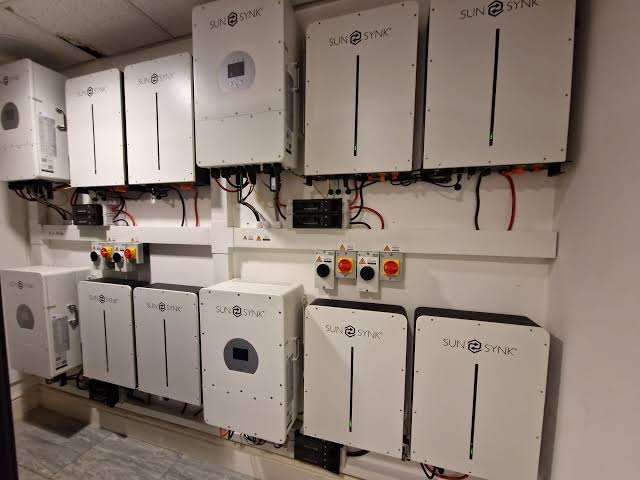
Battery Storage
Battery Storage Installationin Leeds: Hold Your PowerUntil It Is Worth Most
Battery storage installed alongside new or existing solar PV, sized to your evening demand and tariff so generation and cheap-rate electricity are used when they save you the most, fully tested and certified.
MCS registered · NAPIT registered · Works with existing solar
- MCS
- Registered installer
- Retrofit
- Works with existing solar systems
- NAPIT
- Registered and independently assessed
- 17 years
- In the electrical trade
- 4.9 / 5
- From 105 Google reviews
Service overview
Battery storage
What it is
Battery storage stores electricity, from your solar generation, or from the grid during a cheap tariff period, and releases it when you need it and it costs most to buy. The installation comprises the battery unit, a hybrid or AC-coupled inverter, protection and isolation, metering and control, and the connection into your consumer unit or distribution board.
The control system is what makes it worthwhile: charging from surplus generation, charging from the grid on time-of-use tariffs, discharging across the evening peak, and, where specified, providing backup supply to selected circuits during an outage.
Systems are installed alongside new solar or retrofitted to existing arrays, with the same testing, certification and MCS-registered documentation.
Who it is for
Solar owners exporting a large share of generation and buying it back at peak rate in the evening.
Households on time-of-use tariffs who can charge cheaply overnight and avoid the peak entirely.
Homes with EVs and heat pumps, where evening demand is high and the value of stored energy is greatest.
Businesses with an evening or early-morning demand shoulder, or who want resilience for critical loads.
Anyone planning solar who wants the provision designed in now, even if the battery comes later.
When you need it
At the same time as a solar installation, when the shared inverter and electrical work make it substantially cheaper.
As a retrofit, when your existing system exports heavily and you are buying back at peak.
When moving to a time-of-use tariff, which changes the economics considerably even without solar.
When adding an EV charge point or heat pump, both of which increase evening demand.
When power cuts have consequences and backup for selected circuits is worth having.
Why it matters
Solar without storage exports its surplus at whatever the export rate happens to be and buys it back at retail rate a few hours later. Storage closes that gap. On a typical household with daytime generation and evening occupancy, the difference between exporting a surplus and consuming it later is the difference between a mediocre return and a good one.
Sizing decides whether that happens. A battery too small for your evening demand runs flat before the peak ends; one too large for your generation and tariff never fills, and you have paid for capacity that sits idle. The right size follows from your consumption shape, your generation profile and your tariff: three things a competent installer looks at before quoting.
Installation is high-current DC work in a domestic or commercial setting, and it deserves electricians who test installations for a living. Position and ventilation, cable sizing and protection, isolation and labelling for emergency services, and correct integration with the existing board are all ordinary electrical competence applied properly, which is exactly what we do.
The cost of leaving it
What happens when battery storage is put off
The most common way money is wasted on storage is capacity that never gets used. A large battery bought without reference to consumption spends its life partially cycled, and the payback stretches out past any reasonable planning horizon. The opposite error is just as common: a small unit that empties by eight in the evening, leaving the household buying at peak anyway.
Poor integration causes ongoing losses that nobody notices. A control setup that does not know your tariff will charge from the grid at the wrong time or export surplus rather than store it. Systems retrofitted to existing solar without proper metering frequently fail to prioritise self-consumption at all, quietly cancelling the reason the battery was bought.
The safety and practical considerations are real too. Batteries are significant stored-energy devices that need correct positioning, ventilation, temperature consideration, protection, isolation and clear labelling for emergency services. Units installed in unsuitable locations by installers focused on the sale rather than the electrical detail create both a hazard and an access problem when maintenance is eventually needed.
Mistakes we are called in to correct
- Buying capacity based on a headline figure rather than on measured evening consumption and generation.
- Retrofitting storage without the metering and control needed to prioritise self-consumption properly.
- Ignoring tariff structure, which on a time-of-use tariff can matter as much as the solar array itself.
- Positioning the unit where temperature, ventilation or access is poor, which shortens life and complicates maintenance.
- Assuming any battery gives whole-house backup during a power cut: that depends on the inverter and on a specifically wired backup arrangement.
Our process
How we deliver battery storage
- Step 1
Consumption, generation and tariff review
We look at your demand shape across the day, what your solar produces if you have it, and your tariff structure. That determines whether storage pays and, if so, what size genuinely suits you.
- Step 2
System design and siting
Battery capacity, inverter architecture, hybrid for new solar, AC-coupled for retrofit, position, ventilation, cable routes, protection and whether backup circuits are wanted are all specified before quoting.
- Step 3
Installation
The unit is mounted in the agreed position, DC and AC cabling installed with correct protection and isolation, the inverter connected, and the system integrated into your board with clear labelling.
- Step 4
Testing, configuration and commissioning
The installation is electrically tested and certified, charge and discharge behaviour configured to your tariff and consumption, monitoring set up, and network notification completed where required.
- Step 5
Handover and optimisation
You get MCS documentation, electrical certification and a walkthrough of the app and settings, plus a reference point if your tariff or usage changes and the configuration should change with it.
Benefits
What you get from working with us
Generation used, not given away
Surplus stored and consumed in the evening instead of exported at low value and bought back at peak rate.
Cheap-rate charging
Where your tariff allows, the battery charges overnight at low cost and carries you through the expensive part of the day.
Sized against your real demand
Capacity chosen from your evening consumption and generation profile, so you pay for storage you will actually cycle.
Backup where it matters
Selected circuits can be arranged to stay supplied during an outage where the inverter and design support it.
Retrofit to existing solar
AC-coupled installation onto an existing array, with the metering and control needed to actually prioritise self-consumption.
Installed by testing electricians
Positioning, protection, isolation and labelling done to the standard of a firm that inspects and certifies installations for a living.
In detail
Battery Storage explained in full
How storage is sized
Sizing starts with your evening consumption: the kilowatt-hours you use between the point generation drops off and the point demand falls overnight. That is the load storage exists to cover, and matching capacity to it is the single most important decision in the specification.
Generation surplus sets the ceiling on what solar can contribute: a battery larger than your typical daily surplus will only fill fully by importing. Tariff structure then changes the calculation completely, on a time-of-use tariff, grid charging during the cheap window means the battery can be sized to daily consumption rather than to solar surplus, which often justifies more capacity than solar alone would.
Hybrid, AC-coupled and DC-coupled systems
A hybrid inverter handles both solar and battery in a single unit and is the efficient choice when both are installed together: one inverter, one set of electrical work, fewer conversion losses between generation and storage.
AC-coupled storage adds its own inverter alongside the existing solar inverter, and is the standard route for retrofitting onto an existing array without replacing equipment that is working perfectly well. There is a small additional conversion loss, offset by not throwing away a functioning inverter. DC-coupled retrofits connect on the solar side and can be more efficient, but require compatible equipment and are not always available on an existing installation.
Backup supply during an outage
Storage does not automatically keep your lights on in a power cut. Feeding a property during a network outage requires an inverter with backup capability and a specifically wired arrangement that isolates the property from the network: a safety requirement, since exporting into a supposedly dead network endangers people working on it.
In practice, backup is normally arranged for selected essential circuits rather than the whole property: lighting, sockets for fridges and freezers, broadband, heating controls. Duration depends on the battery's remaining charge and the load, and the design decision is which circuits are worth keeping and for how long. If backup matters to you, say so at survey; it changes both the inverter selection and the wiring.
Domestic and commercial storage
Domestic storage is about evening peak and tariff arbitrage, with a wall or floor-mounted unit typically in a garage, utility or plant space where temperature is stable and access is good. It works hardest in households with solar, an EV, a heat pump, or a time-of-use tariff, and best where several of those are true at once.
Commercial storage adds different drivers: managing demand peaks, supporting EV charging without upgrading the incoming supply, resilience for critical operations, and shifting load away from expensive periods. Sizing follows the site's half-hourly demand profile rather than a household's daily rhythm, and the interaction with existing distribution and load management is central to the design. In both cases, the electrical installation behind the battery falls within your periodic inspection regime, which we also deliver.
FAQs
Battery Storage: common questions
How much does battery storage cost?
+It depends on capacity, whether it is installed with new solar or retrofitted, the inverter architecture and whether backup circuits are wanted. We review your consumption and tariff and quote against a specific design, free, no obligation, and accept BACS and all major cards.
Can I add a battery to my existing solar system?
+Yes. AC-coupled storage adds its own inverter alongside your existing solar inverter, so you keep equipment that is working fine. We check the existing installation, metering and board capacity at survey.
What size battery do I need?
+It follows from your evening consumption, your generation surplus and your tariff. We look at all three rather than recommend a standard size: an undersized unit empties before the peak ends and an oversized one never cycles fully.
Will it keep my power on during a cut?
+Only if the system is specified for it. Backup requires an inverter with that capability and a specifically wired arrangement, normally covering selected essential circuits rather than the whole property. Tell us at survey if it matters, because it affects equipment selection.
How long does a battery last?
+Storage batteries are rated for a defined number of charge cycles and a warranted service life, and their usable capacity declines gradually rather than failing suddenly. Correct siting, stable temperature, adequate ventilation, has a real effect on how they age, which is why positioning is part of the design rather than an afterthought.
Does it work without solar?
+Yes, where you are on a time-of-use tariff. The battery charges during the cheap window and discharges through the expensive one, which can be worthwhile on its own: particularly with an EV or electric heating.
How long does installation take?
+A retrofit is typically a day or so including testing and commissioning; installed alongside new solar it forms part of that programme. We confirm the timeline with the design proposal.
What certification do I get?
+MCS-registered documentation and electrical certification for the installation, with network notification handled where required. Both matter for export arrangements, warranties and any future property sale.
Which areas do you cover?
+Leeds, Wakefield, Harrogate, York, Doncaster, Sheffield, Hull and Manchester from our base in Leeds. Call 0113 418 2086 to talk through your consumption and tariff.
Accreditations
Independently assessed,
not self-certified
NAPIT registered, CHAS accredited, SafeContractor approved and MCS registered. City & Guilds 2391 Inspection & Testing and 18th Edition held. Fully insured: details available on request.



Stop exporting cheap and buying back expensive
Tell us your usage, your tariff and whether you already have solar. We will size storage that pays, install it properly and certify it.
Reviews
Rated 4.9 out of 5
by 105 local clients
Landlords, homeowners, letting agents, offices and industrial sites. Read them in full on Google.
“Harry is reliable, trustworthy and professional. He knows what he is doing and keeps records of the work that he has done and always responds in a timely manner.”
“I needed an EICR on my rental property and Pyramid were there the next day. I cannot recommend these guys enough. 5 stars isn't enough!”
“Harry even went the extra mile and worked on a Sunday at no additional charge at late notice to complete the work as we needed the EICR to complete our mortgage. Very quick turnaround from initial contact, through to survey, through to remedial works being completed.”
“Called Harry after being let down by another company who failed to show up. Came round within an hour as promised. The work was carried out to a very high standard and the price was very reasonable.”
“I recommend Harry and his team to all my clients for any electrical needs. My clients always compliment him on his work each time and how reliable he has been.”
“I sought 2 other quotes from other reputable businesses, however, I found Harry's quote to be the most competitive. His pricing was transparent and I would not hesitate to recommend Pyramid Services to others.”
“We have used Harry and Joe numerous times over several years, for different size projects, both inside and outside. They have converted all our offices to LED lighting.”
Request a quote
Book your electrical testing
with one accountable specialist
Tell us the premises and what you need certified. We will confirm scope and give you a free, no-obligation quote, then test, certify and put right anything that fails.
- Call
- 0113 418 2086
- Address
- Ste 1, Regent, Regent St, Leeds LS9 7RD