
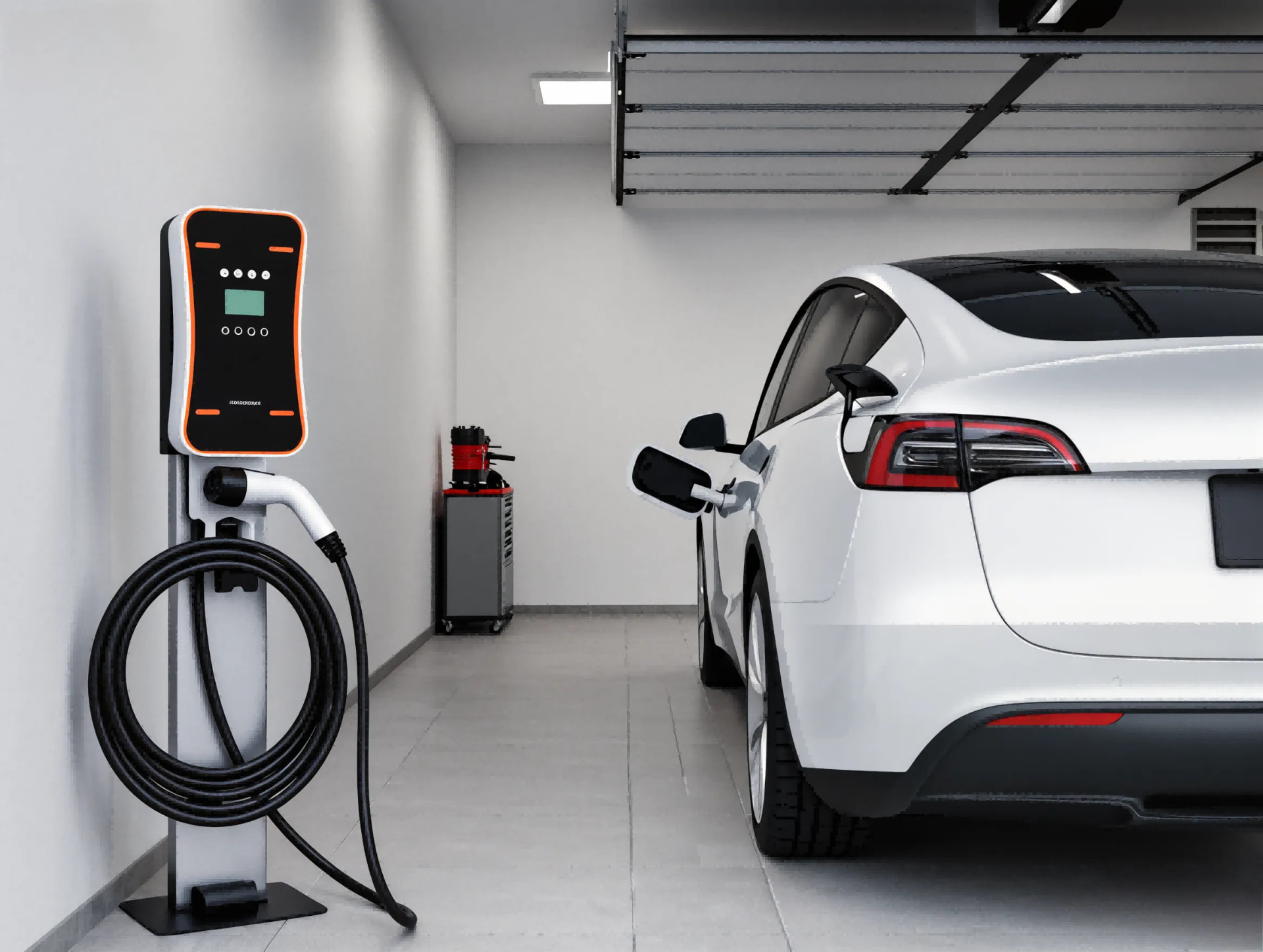
EV Charger Installation & Testing
EV Charger Installation& Testing in Leeds:Installed, Commissioned, Certified
Home, workplace and fleet charge points installed on a supply that has been assessed properly, commissioned to the wiring regulations and certified, so the unit charges at its rated output without tripping the house every evening.
NAPIT registered · 18th Edition qualified · 4.9 from 105 Google reviews
- NAPIT
- Registered and independently assessed
- 18th Edition
- Qualified engineers, 2391 tested
- Certified
- Commissioning certificate issued
- 17 years
- In the electrical trade
- 4.9 / 5
- From 105 Google reviews
Service overview
EV charger installation/testing
What it is
EV charge point installation covers everything between your incoming supply and the vehicle: assessing the existing supply and consumer unit, running a dedicated protected circuit, mounting and connecting the charger, configuring load management where the supply requires it, and commissioning and testing the finished installation.
The charger is the simple part. The work that determines whether the installation is safe and reliable is upstream: the condition and capacity of the supply, the earthing arrangement, the protective device selection, and the RCD type required for a circuit that can produce DC residual current.
You receive certification for the new circuit and a commissioning record for the unit, which is what a warranty claim, a house sale or an insurer will ask for later.
Who it is for
Homeowners installing a charge point on a driveway, in a garage or on an outbuilding.
Landlords adding charging to a rental property, where the new circuit must also be reflected in the property's electrical certification.
Businesses providing workplace charging for staff and visitors, often with multiple units on a shared supply.
Fleet operators charging vans or pool vehicles overnight, where simultaneous demand has to be managed against the site supply.
When you need it
Before a new vehicle arrives, so the charge point is live on day one rather than three weeks later.
When your existing charger is tripping, charging slowly, or was installed without certification.
When adding further units to a site and the original supply assessment no longer covers the total demand.
During a consumer unit upgrade or rewire, when adding the circuit is far cheaper than retrofitting it later.
Why it matters
An EV charger is one of the heaviest sustained loads a domestic installation will ever carry: several hours at close to its rated current, most nights. Installations that would cope with intermittent kitchen loads reveal every weakness under that duty: undersized tails, tired terminations, borderline earthing arrangements and boards with no spare capacity.
The earthing arrangement is the technical crux. On a supply where the earth is provided by the distributor, an open-circuit fault on the network can raise the potential of exposed metalwork, and a car on a driveway is exposed metalwork you can touch while standing on real ground. That is why compliant installations use either an earth electrode arrangement or a charger with integrated open-PEN protection, and it is the single most common thing done badly by cheap installers.
We assess the supply first and tell you what the property actually needs, including where a consumer unit upgrade or a load-managed installation is the right answer. Then we install, test and certify it, and it is the same team you call if anything needs attention later.
The cost of leaving it
What happens when ev charger installation & testing is put off
The cheap installation reveals itself within weeks. The charger trips the board part-way through a charge, the car is at 40% in the morning, and the fix offered is to turn the charging current down, which means paying for a 7kW unit and running it as a slow charger indefinitely.
The safety failures are less visible and considerably more serious. Missing or inappropriate DC-sensitive residual current protection leaves a circuit whose RCD can be blinded by DC leakage from the vehicle. An unresolved earthing arrangement leaves an exposed vehicle body connected to a distributor earth with no protection against a broken neutral on the network. Neither shows up until the specific fault occurs, and both are entirely avoidable at installation.
Then there is the paperwork. An uncertified charge point circuit shows up on the next EICR as an observation, on a house sale as a query from the buyer's solicitor, and on a warranty claim as a reason to decline. Retrofitting the certification means retesting the circuit anyway, so nothing is saved by skipping it.
Mistakes we are called in to correct
- Buying on unit price alone, when the cost difference between installations is almost entirely in the supply work upstream of the charger.
- Adding a charge point to a consumer unit with no spare capacity or no suitable protective device, then living with nuisance tripping.
- Ignoring the earthing arrangement, which is the one aspect of EV installation that genuinely differs from ordinary circuit work.
- Installing multiple workplace units without a load assessment, then discovering the supply cannot serve them simultaneously.
- Accepting an installation with no certificate and no commissioning record.
Our process
How we deliver ev charger installation & testing
- Step 1
Supply and site assessment
We check the incoming supply capacity, earthing arrangement, consumer unit condition and spare ways, plus cable route, mounting position and how you will actually park. That determines the honest scope and the quote.
- Step 2
Design and unit selection
We confirm charge rate, whether load management or open-PEN protection is required, protective device and cable sizing, and, for multi-unit sites, how simultaneous demand will be shared across the available supply.
- Step 3
Installation
A dedicated circuit is installed with the correct protection, cable routed and contained neatly, and the unit mounted where the lead reaches comfortably without being dragged across a driveway.
- Step 4
Testing and commissioning
The circuit is tested to the wiring regulations, protective devices verified, earthing arrangement proven, and the charge point commissioned and connected to its app or back office where applicable.
- Step 5
Handover, certification and support
You receive the electrical certificate and commissioning record, a walkthrough of the unit's operation, and a direct line to the same engineers if anything needs attention afterwards.
Benefits
What you get from working with us
Charges at its rated output
A supply assessment done first means the unit delivers what you paid for, rather than being derated to stop it tripping.
Correct protection for EV loads
DC-sensitive residual current protection and a properly resolved earthing arrangement: the two things cheap installations get wrong.
Certified and documented
Electrical certification and a commissioning record for the file, which matters at your next EICR, at sale, and on any warranty claim.
Multi-unit sites that actually work
Load management designed around your real supply so several vehicles can charge overnight without overloading the incomer.
Neat, considered installation
Cable routes, containment and unit position planned around how you park and use the space, not around the shortest run for the installer.
One contractor afterwards
The same NAPIT-registered team that installed it handles faults, upgrades and the wider installation, including your consumer unit and testing.
In detail
EV Charger Installation & Testing explained in full
Earthing arrangements and open-PEN protection
Charge point installations are treated differently to ordinary outdoor circuits because a vehicle body is a large item of exposed metalwork touched by someone standing outside the building's equipotential zone. Where the supply earth comes from the distributor's combined neutral and earth conductor, a network fault can raise that earth's potential relative to true earth.
There are two accepted routes: install an earth electrode arrangement dedicated to the charge point, or use a unit with integrated open-PEN detection that disconnects all live conductors including the neutral when it detects the condition. Which one is appropriate depends on the supply, the ground conditions and the unit selected, and it is decided at survey, not improvised on installation day.
Single units, load management and multi-unit sites
A single domestic unit is usually a straightforward dedicated circuit, provided the consumer unit has capacity and the supply can carry the additional sustained load alongside showers, ovens and heat pumps. Where it cannot, dynamic load management lets the charger modulate its output based on measured whole-property demand, which is often better value than a supply upgrade.
Workplace and fleet installations are a design exercise. Ten units at full output rarely fit within an existing supply, so the sensible arrangement shares available capacity across active vehicles, prioritising by need or dwell time. Back-office platforms add user authentication, usage reporting and billing where staff or visitor charging needs to be recovered.
Domestic and commercial differences
Domestic installations are about the supply, the route and the position: cable through a wall or across a garage, unit mounted so the tethered lead reaches the port without stretching, and protection sized for a load that runs for hours. Weatherproofing and mechanical protection matter where the unit sits in a driveway or car park.
Commercial installations add civils, containment across car parks, bollard protection, lighting and CCTV coverage of bays, three-phase supplies where higher output units are specified, and the wider question of how charging fits into the site's electrical capacity, which is also where solar PV and battery storage become relevant, since generation and stored energy can serve daytime charging directly.
Existing installations and retrofits
Many enquiries we take are second-fix problems: a unit installed by someone else that trips, charges slowly, or has no certificate. We test the existing circuit, identify whether the fault is the supply, the protection, the earthing arrangement or the unit itself, and quote the specific correction rather than defaulting to a replacement.
Where an older consumer unit cannot accommodate the circuit safely, upgrading the board is usually the right first step, and doing it at the same time as the charge point installation avoids paying twice for the same isolation and the same visit.
FAQs
EV Charger Installation & Testing: common questions
How much does EV charger installation cost?
+It depends far more on the supply work than the charger: cable run length, consumer unit condition and spare capacity, earthing arrangement, and whether load management is needed. We survey and quote against your property, free, no obligation, and accept BACS and all major credit and debit cards.
How long does installation take?
+A straightforward domestic installation is typically a day, including testing and commissioning. Longer cable runs, consumer unit work, or multi-unit commercial installations take longer, and we confirm the expected time with the quote.
Will my consumer unit need upgrading?
+Sometimes. The board needs a spare way, suitable protection and to be in a condition that supports adding a heavy sustained load. We assess it at survey and tell you honestly, rather than adding a circuit to a board that should not take one.
Can I have a charger if my supply is limited?
+Usually yes, using dynamic load management, where the charger modulates its output based on the rest of the property's demand. It is often better value than upgrading the incoming supply, and it prevents the main fuse being the weak point.
What certification do I get?
+Electrical certification for the new circuit and a commissioning record for the charge point. Keep both; they are asked for at your next EICR, on a property sale, and on any manufacturer warranty claim.
Can you fix or replace a charger installed by someone else?
+Yes. We test the existing circuit and installation, identify whether the problem is supply, protection, earthing or the unit itself, and quote the specific fix. Uncertified existing installations can be tested and certified where they are compliant.
Do you install workplace and fleet charging?
+Yes: multiple units with load management, three-phase supplies where higher outputs are specified, and back-office access control and usage reporting where charging needs to be tracked or recovered.
How long should a charge point last?
+Charge points are designed for years of daily outdoor use, and the installation around them lasts as long as any other well-installed circuit. Reliability problems are overwhelmingly installation-related rather than unit failures, which is why the supply assessment matters more than the badge on the box.
Which areas do you cover?
+Leeds, Wakefield, Harrogate, York, Doncaster, Sheffield, Hull and Manchester from our base in Leeds. Call 0113 418 2086 to arrange a survey.
Accreditations
Independently assessed,
not self-certified
NAPIT registered, CHAS accredited, SafeContractor approved and MCS registered. City & Guilds 2391 Inspection & Testing and 18th Edition held. Fully insured: details available on request.



Get a charge point that charges at full output, first time
Tell us the property, the vehicle and where you park. We will assess the supply, quote against real scope, and install, test and certify it properly.
Reviews
Rated 4.9 out of 5
by 105 local clients
Landlords, homeowners, letting agents, offices and industrial sites. Read them in full on Google.
“Harry is reliable, trustworthy and professional. He knows what he is doing and keeps records of the work that he has done and always responds in a timely manner.”
“I needed an EICR on my rental property and Pyramid were there the next day. I cannot recommend these guys enough. 5 stars isn't enough!”
“Harry even went the extra mile and worked on a Sunday at no additional charge at late notice to complete the work as we needed the EICR to complete our mortgage. Very quick turnaround from initial contact, through to survey, through to remedial works being completed.”
“Called Harry after being let down by another company who failed to show up. Came round within an hour as promised. The work was carried out to a very high standard and the price was very reasonable.”
“I recommend Harry and his team to all my clients for any electrical needs. My clients always compliment him on his work each time and how reliable he has been.”
“I sought 2 other quotes from other reputable businesses, however, I found Harry's quote to be the most competitive. His pricing was transparent and I would not hesitate to recommend Pyramid Services to others.”
“We have used Harry and Joe numerous times over several years, for different size projects, both inside and outside. They have converted all our offices to LED lighting.”
Request a quote
Book your electrical testing
with one accountable specialist
Tell us the premises and what you need certified. We will confirm scope and give you a free, no-obligation quote, then test, certify and put right anything that fails.
- Call
- 0113 418 2086
- Address
- Ste 1, Regent, Regent St, Leeds LS9 7RD