
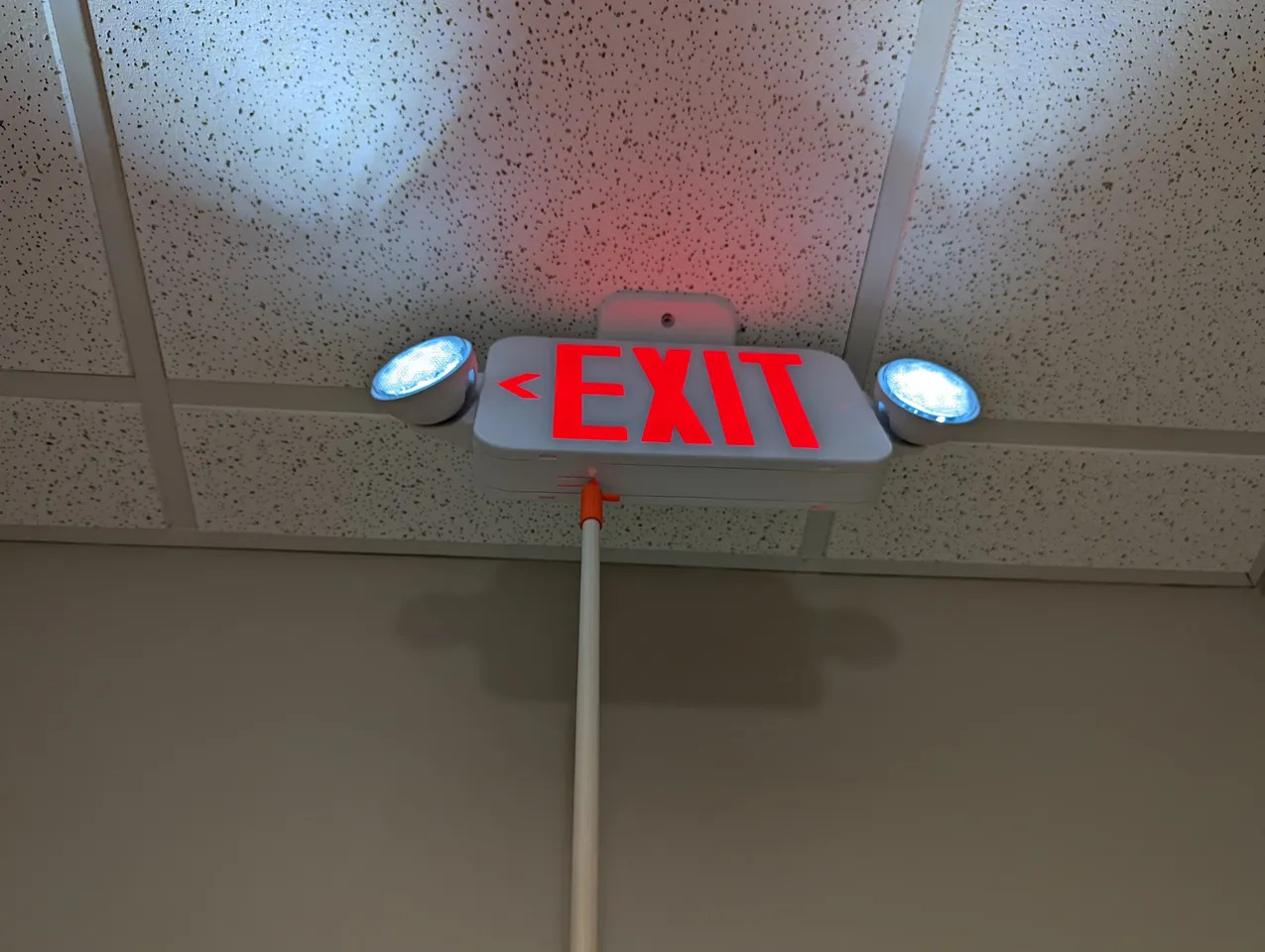
Emergency Lighting Testing
Emergency Lighting Testingin Leeds: Duration Tested,Logbook Certified
Monthly function and annual three-hour duration testing carried out and documented properly, with failed fittings, tired batteries and dark spots on the escape route repaired by the same engineers on the same contract.
CHAS accredited · SafeContractor approved · Remedials completed in-house
- 3-hour
- Full duration testing carried out
- CHAS
- Accredited for health and safety
- In-house
- Failed fittings replaced by our engineers
- 17 years
- Commercial electrical experience
- 4.9 / 5
- From 105 Google reviews
Service overview
Emergency lighting testing
What it is
Emergency lighting testing proves that when the normal supply fails, the escape routes, stairwells, changes of level, final exits, fire alarm call points and firefighting equipment remain visible and illuminated for long enough to get everyone out safely.
There are two routine tests. The monthly function test is a brief simulated supply failure confirming each luminaire and exit sign illuminates and its charging indicator behaves correctly. The annual test is a full-duration discharge, normally three hours, proving the batteries genuinely hold their rated duration rather than lighting for ten minutes and dying.
Both tests must be recorded. The logbook is the evidence a fire officer, insurer or responsible person relies on, and it needs to show dates, results, failures and the corrective action taken.
Who it is for
Responsible persons under fire safety legislation for any non-domestic premises: offices, shops, warehouses, factories, salons, gyms, restaurants and pubs.
Landlords of blocks of flats and HMOs with communal escape routes, stairwells and corridors.
Schools, nurseries, care settings, places of worship, community and village halls.
Facilities managers running multi-site portfolios who need consistent records across every building.
When you need it
Monthly, for the short function test of every luminaire and exit sign.
Annually, for the full three-hour duration test with a written record of results.
After any alteration to the layout, partitioning, escape route or lighting design.
When taking on a building where the logbook is missing, incomplete or plainly filled in retrospectively.
When fittings are visibly failing: dead charge indicators, discoloured diffusers, or signs that have been dark for months.
Why it matters
Emergency lighting is the only system in a building whose entire purpose is to work on the worst day it ever has. It sits idle for years, its batteries degrade quietly, and nothing tells you it has failed until the supply drops and half the escape route stays dark.
Duration testing is the test that gets skipped, because it takes three hours and leaves a building with discharged batteries for a recharge period afterwards. A function test proves a fitting lights; only a duration test proves it will still be lit when people are still on the stairs. Batteries that pass a function test at year five routinely fail duration at forty minutes.
We carry out both tests, record them properly, and replace what fails. Because we are a full electrical contractor rather than a testing-only outfit, a failed fitting is replaced and retested on the same contract rather than becoming an open action in a logbook that never closes.
The cost of leaving it
What happens when emergency lighting testing is put off
The failure scenario is specific and grim: a supply failure or a fire that takes out the lighting circuits, in a building where the batteries have degraded to twenty minutes, with occupants on an unfamiliar escape route in smoke. Emergency lighting exists precisely for that moment, and a system that has not been duration tested is an assumption rather than a protection.
The regulatory exposure is direct. The responsible person under fire safety legislation is required to maintain fire safety provisions in effective working order, and emergency lighting records are among the first things requested during a fire safety inspection. A missing or fabricated logbook is a compliance failure in its own right, quite apart from whether the lights work.
There is a commercial edge too. Buildings routinely fail insurance surveys, licensing inspections and tenant handovers on emergency lighting records alone. Sorting it retrospectively is always more expensive and more disruptive than running the schedule: a system left untested for years usually needs a batch of battery and fitting replacements at once, at the worst possible time.
Mistakes we are called in to correct
- Recording monthly function tests that were never actually carried out, which is worse than having no logbook at all when it is examined.
- Skipping the annual duration test because of the three-hour discharge and recharge, and assuming a function test covers it.
- Testing the system but never closing out the failures, so the same fittings appear as faults year after year.
- Altering partitions, corridors or door positions without reassessing coverage, leaving new dark spots on the escape route.
- Assuming a new-build system needs nothing for years: batteries begin degrading from day one, and commissioning defects are common.
Our process
How we deliver emergency lighting testing
- Step 1
System survey and asset schedule
We identify and schedule every luminaire, exit sign and self-contained or central battery unit, note the type and location of each, and check that coverage matches the current layout of escape routes and exits.
- Step 2
Function testing
Each fitting is simulated into emergency mode, illumination is confirmed, and charge indicators are checked, with any fitting that fails to strike recorded immediately against its location.
- Step 3
Full duration testing
The annual three-hour discharge is run and monitored, and fittings that fail before the rated duration are identified: the test that finds tired batteries a function test cannot.
- Step 4
Certification and logbook entry
Results are recorded against every asset, the logbook is completed with dates, findings and outstanding actions, and you receive certification suitable for your fire risk assessment file.
- Step 5
Remedials, replacement and re-test
Failed batteries, fittings and signs are replaced by our engineers, coverage gaps are addressed, and everything replaced is retested and recorded so the system leaves fully compliant.
Benefits
What you get from working with us
Escape routes that stay lit
Full-duration proof that the system delivers its rated three hours, not just an initial flicker of light when the supply drops.
A logbook that survives inspection
Dated, asset-level records of function and duration testing with failures and corrective actions closed out: the evidence a fire officer or insurer expects.
Failures fixed, not logged forever
Our engineers replace failed fittings and batteries on the same contract, so the outstanding-actions list actually reaches zero.
Coverage checked against your layout
Partitions move, doors change, extensions get built. We check the system still lights the routes people will actually use.
Testing planned around occupancy
Duration tests scheduled so the recharge period does not leave the building unprotected during occupied hours.
One contractor for fire-related testing
Emergency lighting alongside fire alarm testing, fixed wire testing and PAT under a single accredited business with one point of accountability.
In detail
Emergency Lighting Testing explained in full
Maintained, non-maintained and sustained fittings
Non-maintained fittings only illuminate when the normal supply fails, and are typical in workplaces occupied during daylight with good general lighting. Maintained fittings are lit at all times, which is why they are used in places of assembly, cinemas, clubs and venues where the space may be dark or unfamiliar while occupied. Sustained fittings combine both, with separate lamps for normal and emergency operation.
Exit signage is a category of its own. Legibility distance, viewing angle and pictogram compliance matter as much as illumination, and signs that were correct when installed can be obscured by later partitioning, signage clutter or racking. We check that the sign can still be seen from the point a person needs to see it.
Self-contained versus central battery systems
Self-contained fittings hold their own battery, charger and control gear. They are simple, resilient, a single failure affects one fitting, and the most common arrangement in small and medium commercial premises. Testing means addressing each fitting individually, which is why an accurate asset schedule matters so much.
Central battery systems supply multiple luminaires from one battery installation, which concentrates maintenance in one location but also concentrates the risk: a central failure can affect an entire building's emergency lighting. These systems need particular attention to the battery room, charger condition, sub-circuit monitoring and the integrity of the distribution to the fittings.
Automatic test systems can perform function and duration tests on a schedule and log the results, which suits large or complex sites. They still need periodic physical inspection: an automatic system reports what its monitoring can see, not whether a fitting has been obscured by new racking or a sign has been painted over.
Where emergency lighting is required
Coverage is driven by the escape route and the hazards along it: corridors and stairways, changes of direction and level, intersections, final exits and outside them, fire alarm call points, firefighting equipment, first aid points, lifts, toilets over a certain size, and open areas needing anti-panic illumination.
High-risk task areas add a further requirement: places where an unlit sudden shutdown would itself be dangerous, such as around machinery that needs to be brought to a safe stop. Industrial sites frequently have adequate escape lighting and no provision at all for high-risk task areas, which is one of the more common findings on a first survey.
Commercial and residential differences
In commercial premises the responsible person under fire safety legislation carries the duty, the logbook is the primary evidence, and testing is usually contracted alongside fire alarm servicing. Layout changes are frequent and coverage needs re-checking more often than most managers expect.
In residential blocks and HMOs, emergency lighting covers communal areas, stairwells, corridors, lobbies and external routes to a place of safety, and the freeholder or managing agent carries the duty. Access to communal areas is easier than to individual flats, so testing is straightforward, but records are often the weakest part of the file when a block changes management. Rebuilding an asset schedule and a clean logbook is usually the first job we do on those buildings.
FAQs
Emergency Lighting Testing: common questions
How much does emergency lighting testing cost?
+It is priced by the number of fittings, the building layout and access, and whether we are building the asset schedule from scratch. We quote per site after establishing the real count, free, with no obligation, and we accept BACS and all major credit and debit cards.
How often does emergency lighting need testing?
+A short function test monthly, and a full duration test, normally three hours, annually, with both recorded in the logbook. Systems also need re-checking after any change to layout, partitioning or escape routes.
What is the difference between the monthly and annual test?
+The monthly function test confirms each fitting illuminates when the supply is simulated as failed. The annual duration test proves the batteries hold their full rated duration. A fitting can pass the function test and fail at forty minutes, which is exactly why the annual test matters.
How long does the annual test take?
+The discharge itself runs for the rated duration, normally three hours, plus inspection time and the recharge period afterwards. We schedule it so the recharge does not leave the building unprotected during occupied hours, including out-of-hours where the site needs it.
What happens if fittings fail the test?
+We record the failure against the specific fitting and location, quote the remedial work, and our own engineers replace failed batteries, fittings and signs and retest them. The logbook is closed out rather than carrying the same faults forward every year.
How long do emergency lighting batteries last?
+Rechargeable emergency lighting batteries degrade with age and temperature and typically need replacing within a few years of installation, which is why duration testing is the test that finds them. Ambient heat shortens their life noticeably, so fittings in warm plant areas fail sooner than those in cool corridors.
Can you fill in the gaps if our logbook is missing?
+Yes. We build a full asset schedule of every luminaire and sign, test the system from scratch, and start a clean, dated logbook. We cannot retrospectively record tests that were never carried out, but you will have a defensible position going forward.
Do you cover blocks of flats and HMOs?
+Yes: communal stairwells, corridors, lobbies and external routes, for freeholders, managing agents and portfolio landlords. Testing communal areas is straightforward, and we can align it with fire alarm testing on the same visit.
Which areas do you cover?
+Leeds, Wakefield, Harrogate, York, Doncaster, Sheffield, Hull and Manchester, from our base in Leeds. Call 0113 418 2086 to arrange a survey.
Accreditations
Independently assessed,
not self-certified
NAPIT registered, CHAS accredited, SafeContractor approved and MCS registered. City & Guilds 2391 Inspection & Testing and 18th Edition held. Fully insured: details available on request.



Prove your escape routes stay lit for the full three hours
Tell us the building and roughly how many fittings you have. We will test, certify, close out the failures and leave you with a logbook that stands up to inspection.
Reviews
Rated 4.9 out of 5
by 105 local clients
Landlords, homeowners, letting agents, offices and industrial sites. Read them in full on Google.
“Harry is reliable, trustworthy and professional. He knows what he is doing and keeps records of the work that he has done and always responds in a timely manner.”
“I needed an EICR on my rental property and Pyramid were there the next day. I cannot recommend these guys enough. 5 stars isn't enough!”
“Harry even went the extra mile and worked on a Sunday at no additional charge at late notice to complete the work as we needed the EICR to complete our mortgage. Very quick turnaround from initial contact, through to survey, through to remedial works being completed.”
“Called Harry after being let down by another company who failed to show up. Came round within an hour as promised. The work was carried out to a very high standard and the price was very reasonable.”
“I recommend Harry and his team to all my clients for any electrical needs. My clients always compliment him on his work each time and how reliable he has been.”
“I sought 2 other quotes from other reputable businesses, however, I found Harry's quote to be the most competitive. His pricing was transparent and I would not hesitate to recommend Pyramid Services to others.”
“We have used Harry and Joe numerous times over several years, for different size projects, both inside and outside. They have converted all our offices to LED lighting.”
Request a quote
Book your electrical testing
with one accountable specialist
Tell us the premises and what you need certified. We will confirm scope and give you a free, no-obligation quote, then test, certify and put right anything that fails.
- Call
- 0113 418 2086
- Address
- Ste 1, Regent, Regent St, Leeds LS9 7RD