
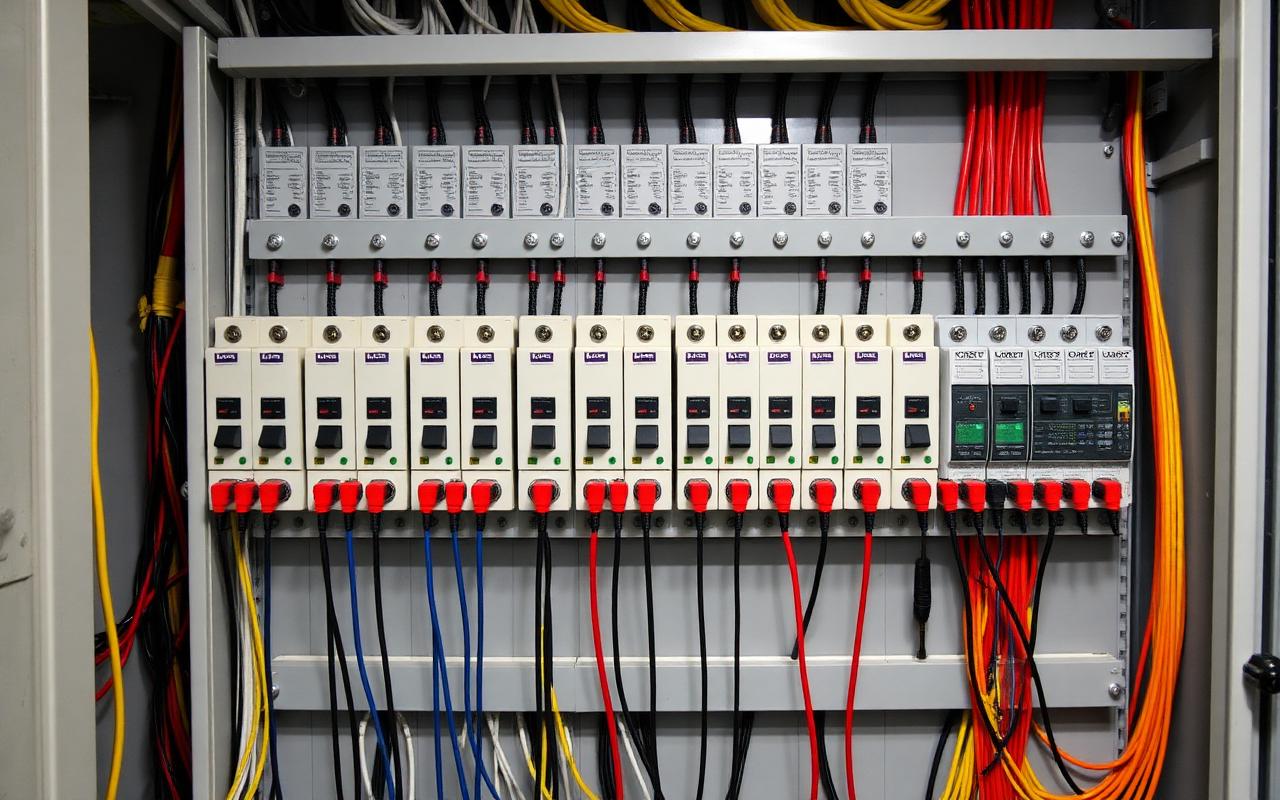
Fixed Wire Testing
Fixed Wire Testingfor Leeds Commercial& Industrial Sites
Periodic inspection and testing of your fixed installation, phased around production and trading hours, delivered with measured results per circuit and remedial works completed by the same engineers rather than passed to another contractor.
CHAS accredited · SafeContractor approved · 17 years in the trade
- CHAS
- Accredited for health and safety
- SafeContractor
- Approved contractor status
- 17 years
- Commercial and industrial experience
- 4.9 / 5
- From 105 Google reviews
- Phased
- Testing planned around your operating hours
Service overview
Fixed wire testing
What it is
Fixed wire testing, also called periodic inspection and testing, or hard wire testing, is the systematic inspection and measurement of everything electrically fixed in a building: the incoming supply and main switchgear, distribution and sub-distribution boards, submains, final circuits, socket outlets, lighting, isolators, machine supplies, earthing and bonding.
It differs from PAT testing, which covers items plugged into the installation. Fixed wire testing covers the installation itself, and the resulting document is an Electrical Installation Condition Report supported by a schedule of test results for every circuit inspected.
On larger sites the work is usually planned as a rolling programme, a defined percentage of the installation each year across the inspection cycle, so that no single shutdown is required and the cost is spread across budget periods.
Who it is for
Facilities and estates managers responsible for offices, retail units, warehouses, schools, care settings and multi-tenanted buildings.
Manufacturing and engineering sites with three-phase distribution, machine supplies, control panels and planned maintenance regimes.
Property managers and commercial landlords who need documented electrical safety across a portfolio on a predictable cycle.
Duty holders who need to demonstrate to an insurer, auditor or enforcing authority that the installation is maintained in a safe condition.
When you need it
On the inspection interval recorded on your last report, commonly five years for commercial premises and three for industrial.
Before an insurance renewal or an audit where the current condition report will be requested.
After a change of use, a fit-out, a machinery installation or any significant alteration to distribution.
When taking on a building whose electrical history is unknown or undocumented.
When protective devices are operating repeatedly, equipment is failing prematurely, or thermal imaging has flagged distribution equipment.
Why it matters
Commercial and industrial installations fail differently to domestic ones. They run closer to their design load, for longer hours, in dirtier environments, with vibration, heat and constant alteration by whichever trade was last on site. Thermal cycling loosens terminations, dust and moisture degrade insulation, and undocumented alterations leave circuits without the protection the original design assumed.
Testing at that scale is a planning exercise as much as a technical one. Isolating a distribution board in a live building means agreeing shutdown windows, identifying what each circuit actually feeds, protecting IT and refrigeration loads, and working evenings, weekends or shutdown periods where the operation cannot take an outage. We plan the programme with you before anyone arrives with a test lead.
Our CHAS accreditation and SafeContractor approval exist because clients at this scale need contractors who can evidence their health and safety management, not just their electrical competence. RAMS, permits, induction and site rules are part of how we work, not an obstacle to it.
The cost of leaving it
What happens when fixed wire testing is put off
The failures that shut a commercial site down are rarely dramatic at the start. A distribution board termination works loose over a few hundred thermal cycles, its resistance rises, it runs hot, and the heat cooks the insulation of everything in the enclosure with it. By the time it announces itself, the outcome is a burnt board, a production stoppage measured in hours or days, and a replacement lead time you do not control.
The commercial consequences travel further than the repair bill. An unplanned outage on a manufacturing line costs the shift, not the fuse. A retail unit without power loses a trading day. An insurer reviewing a fire claim will ask for the current condition report and the maintenance records behind it, and an installation with no evidence of periodic inspection is a difficult position to defend.
Deferring the programme also makes the next one worse. Faults accumulate, undocumented alterations pile up, and what could have been a routine cycle of testing with a handful of remedials becomes a large, disruptive project with a substantial capital ask attached. The sites with the smallest testing budgets are almost always the ones that have not tested for the longest.
Mistakes we are called in to correct
- Comparing quotes without checking the sampling percentage: testing 10% of an installation and testing all of it are very different pieces of work at very different prices.
- Allowing testing to be booked without an agreed shutdown plan, then losing the day when critical loads cannot be isolated.
- Accepting reports with unidentified circuits marked FI year after year, instead of resolving the schedules once.
- Separating the testing contract from the remedial works, which leaves observations open across budget years while the risk stays live.
- Assuming a recent fit-out means the whole installation is compliant, when the fit-out only covered part of it.
Our process
How we deliver fixed wire testing
- Step 1
Site survey and programme
We walk the installation, count boards and circuits, identify critical loads that cannot simply be switched off, and agree the sampling strategy and inspection cycle. You get a written scope and a fixed quote before anything is booked.
- Step 2
Shutdown planning and RAMS
Method statements, risk assessments, permits and access are agreed in advance, and testing windows are set around your operating hours, including evenings, weekends and shutdown periods where the site needs it.
- Step 3
Inspection and testing
Distribution equipment, submains and final circuits are inspected and tested with calibrated instruments, circuit schedules are corrected as we go, and results are recorded against every circuit rather than sampled and generalised.
- Step 4
Reporting and prioritisation
You receive the condition report with coded observations, photographs and full schedules of test results, plus a prioritised remedial list separating what is dangerous now from what should be planned into the next budget cycle.
- Step 5
Remedials, re-test and next cycle
Our engineers complete the corrective work, re-test the affected circuits and issue updated certification, and we diarise the next phase of the programme so nothing lapses.
Benefits
What you get from working with us
Production kept running
Testing phased around shifts, trading hours and shutdown windows, with critical loads identified before any isolation takes place.
Audit-ready documentation
Condition reports with full schedules of test results and photographic evidence, ready for insurers, auditors and enforcing authorities.
Prioritised, budgetable remedials
Observations separated into immediate danger, planned works and improvements, so you can defend spend and phase it properly.
Accurate circuit schedules
Boards relabelled and schedules corrected as part of the work, which removes the guesswork from every future isolation and fault call.
One accountable contractor
Testing and remedials under one business, one set of accreditations and one point of contact: CHAS accredited, SafeContractor approved, NAPIT registered.
Predictable cycles
A rolling programme with agreed percentages each year, so the installation stays certified without an occasional large disruptive project.
In detail
Fixed Wire Testing explained in full
Sampling and rolling programmes
Testing an entire commercial installation in one visit is rarely practical and rarely necessary. The usual approach is a rolling programme: an agreed proportion of circuits inspected and tested each year so that the whole installation is covered across the inspection cycle, with the sampling weighted towards the circuits and areas most likely to have deteriorated.
Sampling has to be defensible. We record which circuits were tested and which were not, weight future phases towards untested areas, and increase the sample where the initial results show a pattern of defects. Where a sample throws up widespread failures, the honest recommendation is to widen the inspection rather than report a satisfactory result on partial evidence.
Three-phase distribution and machine supplies
Three-phase installations bring considerations that do not arise domestically: phase rotation and balance, higher prospective fault currents, discrimination between upstream and downstream protective devices, and the behaviour of motor circuits and variable speed drives during insulation testing. Drives and electronic equipment must be isolated or disconnected before insulation resistance testing to avoid damage, which is a step cheap contractors skip and clients pay for afterwards.
Machine supplies, isolators and control panels sit at the boundary between the fixed installation and work equipment. We test up to and including the fixed supply, identify where responsibility transfers to machinery maintenance, and record it clearly so the boundary is not argued about during an audit.
Environments that change the method
Warehousing and distribution bring high-level distribution, lighting at height and forklift damage to containment and sockets. Food production adds washdown environments where ingress protection and corrosion drive most of the observations. Workshops and engineering shops bring vibration, metal swarf and heavily loaded socket circuits. Offices and data areas add clean power requirements, UPS-backed circuits and IT loads that cannot be dropped without notice.
Multi-tenanted buildings introduce a further complication: landlord and tenant areas often share distribution, and responsibility for testing follows the lease rather than the wiring. We map that boundary at survey so the report covers what you are responsible for and nothing gets missed in the gap between two duty holders.
How fixed wire testing fits with your wider regime
Fixed wire testing is one part of an electrical maintenance regime. Portable appliance testing covers everything plugged in, emergency lighting testing proves the escape route stays lit during a supply failure, fire alarm testing covers detection and warning, and thermal imaging finds developing hot spots between inspection cycles without any shutdown at all.
Running those on complementary schedules gives continuous coverage: annual thermal surveys catch the developing terminations, monthly and annual emergency lighting tests keep the logbook current, and the fixed wire programme provides the underlying condition evidence. We deliver all of them, which means one contractor holds the whole picture of your site rather than four holding fragments of it.
FAQs
Fixed Wire Testing: common questions
How much does fixed wire testing cost?
+It is priced per site, driven by the number of distribution boards and circuits, the sampling percentage, access, and whether testing has to happen outside normal hours. We survey first and quote against the real scope, free and with no obligation, rather than quote a per-circuit rate that changes once we see the installation. BACS and all major credit and debit cards accepted.
How often does a commercial installation need testing?
+Commercial premises such as offices and shops are commonly inspected every five years, and industrial premises every three, with shorter intervals for higher-risk environments. The correct interval depends on the installation type, its use, the environment and the condition found last time; we set and record it on your report.
Do you have to shut the building down?
+No. We phase testing board by board and circuit by circuit around your operating hours, and we identify critical loads at survey so nothing important is isolated without agreement. Where a site genuinely cannot take daytime outages, we work evenings, weekends or planned shutdowns.
Can you work outside our trading or production hours?
+Yes. A large proportion of commercial testing is done outside core hours, and we plan the programme around your operation rather than expecting it to stop. Our reviews include remedial works completed on a Sunday at no additional charge to meet a client's deadline.
Do you carry out the remedial works you identify?
+Yes, with our own engineers, followed by re-testing of the affected circuits and updated certification. We also take on remedials from reports issued by other contractors, which is a common reason clients move their testing to us.
What accreditations do you hold for commercial sites?
+Pyramid Services is CHAS accredited, SafeContractor approved, NAPIT registered and MCS registered. Engineers hold City & Guilds 2391 Inspection & Testing and the 18th Edition, and we are fully insured: details available on request.
Will you correct our circuit schedules and board labelling?
+Yes. Identifying and labelling circuits accurately is part of the work, and it is one of the most useful by-products of a proper programme: every future isolation, fault call and alteration is quicker because the schedules are right.
What is the difference between fixed wire testing and PAT testing?
+Fixed wire testing covers the installation: boards, cabling, sockets, lighting and fixed equipment supplies. PAT testing covers items plugged into it. Most commercial sites need both, and we deliver them on complementary schedules under one contractor.
Which areas do you cover?
+Leeds, Wakefield, Harrogate, York, Doncaster, Sheffield, Hull and Manchester, from our base in Leeds. Call 0113 418 2086 to confirm coverage and discuss a programme for your site.
Accreditations
Independently assessed,
not self-certified
NAPIT registered, CHAS accredited, SafeContractor approved and MCS registered. City & Guilds 2391 Inspection & Testing and 18th Edition held. Fully insured: details available on request.



Put your fixed wire testing on a programme that fits your operation
Tell us the site, the boards and the hours you can release. We will survey, quote against real scope, and phase the testing so the building keeps working.
Reviews
Rated 4.9 out of 5
by 105 local clients
Landlords, homeowners, letting agents, offices and industrial sites. Read them in full on Google.
“Harry is reliable, trustworthy and professional. He knows what he is doing and keeps records of the work that he has done and always responds in a timely manner.”
“I needed an EICR on my rental property and Pyramid were there the next day. I cannot recommend these guys enough. 5 stars isn't enough!”
“Harry even went the extra mile and worked on a Sunday at no additional charge at late notice to complete the work as we needed the EICR to complete our mortgage. Very quick turnaround from initial contact, through to survey, through to remedial works being completed.”
“Called Harry after being let down by another company who failed to show up. Came round within an hour as promised. The work was carried out to a very high standard and the price was very reasonable.”
“I recommend Harry and his team to all my clients for any electrical needs. My clients always compliment him on his work each time and how reliable he has been.”
“I sought 2 other quotes from other reputable businesses, however, I found Harry's quote to be the most competitive. His pricing was transparent and I would not hesitate to recommend Pyramid Services to others.”
“We have used Harry and Joe numerous times over several years, for different size projects, both inside and outside. They have converted all our offices to LED lighting.”
Request a quote
Book your electrical testing
with one accountable specialist
Tell us the premises and what you need certified. We will confirm scope and give you a free, no-obligation quote, then test, certify and put right anything that fails.
- Call
- 0113 418 2086
- Address
- Ste 1, Regent, Regent St, Leeds LS9 7RD