
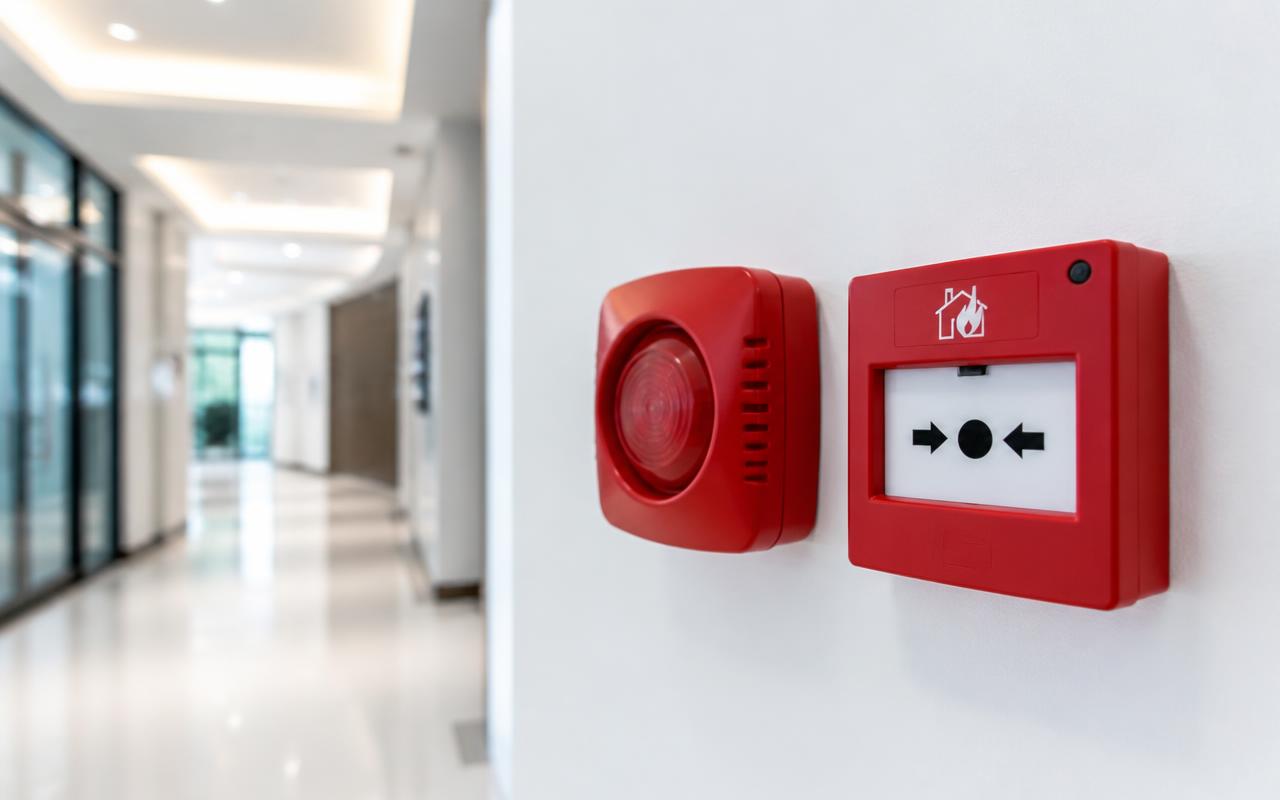
Fire Alarm Testing
Fire Alarm Testingin Leeds: Zone by Zone,Documented for Your Risk Assessment
Weekly call point testing, periodic servicing and device-level inspection carried out and recorded properly, with faulty detectors, sounders and panel faults corrected by the same engineers on the same visit where parts allow.
CHAS accredited · SafeContractor approved · 17 years in the trade
- Zone-level
- Device schedules and test records
- CHAS
- Accredited for health and safety
- SafeContractor
- Approved contractor status
- In-house
- Remedial works and re-testing
- 4.9 / 5
- From 105 Google reviews
Service overview
Fire alarm testing
What it is
Fire alarm testing is the inspection, functional testing and servicing of a building's fire detection and alarm system: the control panel, detectors, manual call points, sounders and beacons, interfaces to door releases and plant, the standby batteries, and the wiring that connects them all.
Routine testing has two layers. The weekly test, normally carried out by the responsible person or a member of staff, operates one call point on a rotating basis to prove the panel receives the signal and the sounders operate. Periodic servicing by a competent engineer covers the whole system across the service cycle: every device functionally tested, panel functions verified, batteries load-tested and cause-and-effect confirmed.
Everything is recorded. The fire logbook, device schedule and service certificate together form the evidence trail your fire risk assessment relies on and that an inspecting officer will ask to see.
Who it is for
Responsible persons for any non-domestic premises with a fire detection and alarm system: offices, shops, warehouses, factories, restaurants, pubs and hotels.
Managing agents and freeholders of residential blocks and HMOs with communal detection and alarm provision.
Schools, nurseries, care settings, places of worship and community buildings.
Facilities managers holding multi-site portfolios who need consistent servicing records and one contractor across every building.
When you need it
Weekly, for the rotating call point test recorded in the logbook.
On the periodic service schedule agreed for your system, so that every device is covered across the cycle.
After any layout change, fit-out, partitioning works or change of use that affects detection coverage.
Following any actual activation, false alarm pattern or panel fault that has not been diagnosed and cleared.
When taking on a building with missing service records, an unlabelled panel or no device schedule.
Why it matters
A fire alarm system is only as good as the last time somebody proved it works end to end. Detectors get painted over, blocked by racking or contaminated by dust; sounders get disconnected during a fit-out; interfaces to door holders and plant get isolated during works and never restored; and panels sit in fault for months because the buzzer was silenced rather than the cause resolved.
Persistent false alarms are a safety problem, not just a nuisance. Once occupants stop believing the alarm, evacuation slows, and a real activation gets treated as another cry of wolf. Most false alarm patterns are traceable to detector type, siting or contamination, a heat detector in a kitchen instead of an optical unit in a corridor, and are solvable rather than something to be tolerated.
Because we are a full electrical contractor, testing and correction happen under one contract. Faults found during a service are quoted, corrected and retested by our own engineers, rather than logged for a specialist who then argues about wiring versus device responsibility.
The cost of leaving it
What happens when fire alarm testing is put off
The scenario that kills people is not an absent alarm; it is a delayed one. A contaminated detector that does not respond, a sounder circuit isolated after a fit-out, or a panel in fault for so long that nobody looks at it any more, all produce the same result: a fire develops for several extra minutes before anyone is warned. In a building with a single protected stairwell, those minutes are the whole evacuation margin.
The enforcement position is unambiguous. The responsible person must keep fire safety provisions in efficient working order and in good repair, and must be able to evidence it. Fire safety inspections start with the logbook and the servicing records, and a system with no device schedule and no dated test records is a finding before an engineer has even lifted a detector head.
Commercially, unresolved alarm issues cost in ways that compound. Repeated false activations cause evacuations, lost trading and, in some areas, chargeable brigade attendance. Insurers and licensing bodies ask for servicing records. And a system neglected for years rarely needs one repair; it needs a batch of detectors, a battery set and a panel fault clearing, all at once, usually the week before an inspection.
Mistakes we are called in to correct
- Signing off weekly tests that never happened, which turns a paperwork gap into a credibility problem during an inspection.
- Silencing recurring panel faults rather than diagnosing them, so a genuine fault sits masked behind a familiar buzzer.
- Fitting the wrong detector type for the environment: the single most common cause of persistent false alarms.
- Changing partitions, racking or room use without reassessing detection coverage, leaving areas effectively unprotected.
- Separating servicing from remedial work, which leaves faults open across service visits while the risk stays live.
Our process
How we deliver fire alarm testing
- Step 1
System survey and device schedule
We identify the panel type, zones and every device on the system, build or correct the device schedule, and check that detection coverage still matches how the building is laid out and used today.
- Step 2
Panel, battery and supply checks
Panel functions, indications, fault history, standby battery condition and charging are checked, because a system with a failing battery set has no protection during the supply failure a fire can cause.
- Step 3
Device and cause-and-effect testing
Detectors, call points, sounders and beacons are functionally tested zone by zone, and interfaces to door releases, plant shutdowns and remote signalling are proven to operate as intended.
- Step 4
Certification and logbook
Results are recorded device by device, outstanding faults are listed clearly, and the logbook and service documentation are completed so your fire risk assessment file is current.
- Step 5
Remedials and re-test
Faulty detectors, sounders, batteries and wiring are corrected by our engineers, and everything touched is retested and recorded so the system is left fully functional, not partially serviced.
Benefits
What you get from working with us
Warning time protected
Every device proven to operate and every interface proven to fire, so detection to evacuation happens in the seconds the design assumed.
Inspection-ready records
Device schedules, dated test results and service certification that stand up when a fire officer, insurer or licensing body asks for evidence.
False alarms diagnosed, not tolerated
Detector type, siting and contamination addressed at source, so evacuations happen for fires rather than for toast and dust.
Faults closed out
Remedial work carried out by the same accredited contractor, with retesting, rather than logged and carried forward to the next service.
Testing planned around occupancy
Sounder testing and evacuations scheduled to suit trading hours, tenants and residents, including out-of-hours where the building needs it.
One contractor for life-safety systems
Fire alarm testing alongside emergency lighting, fixed wire testing and PAT under a single CHAS-accredited, SafeContractor-approved business.
In detail
Fire Alarm Testing explained in full
System categories and what they protect
Fire alarm systems are categorised by what they are designed to do. Category M systems are manual only: call points and sounders, with no automatic detection. Category L systems are for life protection, ranging from detection covering escape routes only through to detection throughout the building. Category P systems are for property protection, driven by insurer requirements rather than escape times.
Knowing the category matters at testing, because it defines what should be there. A building with detection only in corridors is not defective if it was designed as such, but if the use has changed, or sleeping accommodation has been added, the category may no longer suit the building. That is a fire risk assessment finding rather than a test failure, and we flag it clearly rather than silently testing an inadequate system to a clean sheet.
Detector types and false alarm control
Optical smoke detectors respond well to smouldering fires and are the workhorse of corridors and offices, but they are triggered by steam, dust and aerosol. Heat detectors ignore all of that and are the correct choice for kitchens, boiler rooms and dusty workshops, at the cost of slower response. Multi-sensor detectors combine inputs to distinguish a genuine fire signature from a transient nuisance, and are often the fix for a corridor next to a shower room or a kitchen door.
Siting is the other half of the problem. Detectors too close to air handling outlets, kitchen doors, loading bays or heaters generate repeated false activations that no amount of testing will resolve. When we find a pattern, we recommend the change of device type or position rather than continuing to clean and reset the same detector every service visit.
Conventional, addressable and wireless systems
Conventional systems group devices into zones: the panel tells you a zone has activated, not which device. They are common in smaller premises and perfectly adequate, provided zone labelling is accurate, which is why we correct zone charts as part of servicing.
Addressable systems identify each device individually, which speeds up both fire response and fault finding, and allows far more sophisticated cause and effect: specific sounder patterns, staged evacuation, plant shutdowns and door release logic. Testing an addressable system includes verifying that the programmed cause and effect still matches the building's evacuation strategy after fit-outs and layout changes.
Wireless and hybrid systems remove cabling difficulties in listed buildings and occupied premises but add battery management across every device. The service regime has to track battery status device by device, and the device schedule becomes even more important.
Commercial and residential differences
In commercial premises, testing is planned around trading and production: sounder tests at agreed times, coordination with staff so a test is not mistaken for an evacuation, and interfaces to plant, shutters and door holders proven without disrupting operations. Multi-tenanted buildings need clarity about which parts of the system fall to the landlord and which to each tenant.
In residential blocks and HMOs, the communal system and any interlinked detection within flats need consistent servicing, and access is the practical constraint rather than the technical one. Sounder testing has to consider residents including shift workers, and evacuation strategy, stay put versus simultaneous evacuation, determines what the cause and effect should actually do. We test against the strategy in your fire risk assessment, not against a generic template.
FAQs
Fire Alarm Testing: common questions
How much does fire alarm testing and servicing cost?
+It is priced per site by system size, number of devices and zones, panel type and access. We survey and quote against the real system rather than publish a rate that changes on arrival. Quotes are free and carry no obligation, and we accept BACS and all major credit and debit cards.
How often should a fire alarm be tested?
+A call point should be tested weekly on a rotating basis and recorded in the logbook, with periodic servicing by a competent engineer so that every device is covered across the service cycle. Systems also need re-checking after layout changes, fit-outs or a change of use.
Who can carry out the weekly test?
+The weekly call point test is normally carried out by the responsible person or a nominated member of staff; it takes minutes and needs a logbook entry. Periodic servicing, device testing and cause-and-effect verification need a competent engineer, which is where we come in.
Will testing set the alarm off and disrupt the building?
+Sounders are operated during testing, so we agree timing with you first and notify occupants. In trading premises and residential blocks we schedule sounder testing at times that suit, including outside core hours where necessary.
Our panel keeps showing a fault: can you fix it?
+Yes. Persistent panel faults usually trace to a device, a cable fault, an end-of-line problem or a failing battery set, and we diagnose the cause rather than reset the display. Our engineers carry out the repair and retest the affected zone.
Can you stop our false alarms?
+Usually. Most repeat false activations come down to detector type, siting or contamination: an optical detector next to a kitchen door or a shower room, for example. We identify the pattern and recommend the specific change, whether that is a multi-sensor device, a heat detector or a repositioning.
How long do fire alarm standby batteries last?
+Standby batteries degrade over time and need periodic replacement; they are load-tested as part of servicing because a system with tired batteries loses protection precisely when a fire has taken out the supply. We record battery condition at every service and replace before failure rather than after it.
Do you service systems installed by another contractor?
+Yes, and taking over a neglected system is common work for us. We build or correct the device schedule, service the system fully, list outstanding faults clearly and get the logbook into a state that will withstand inspection.
Which areas do you cover?
+Leeds, Wakefield, Harrogate, York, Doncaster, Sheffield, Hull and Manchester from our base in Leeds. Call 0113 418 2086 to arrange a survey of your system.
Accreditations
Independently assessed,
not self-certified
NAPIT registered, CHAS accredited, SafeContractor approved and MCS registered. City & Guilds 2391 Inspection & Testing and 18th Edition held. Fully insured: details available on request.



Get your fire alarm serviced, documented and actually working
Tell us the building and the panel. We will survey the system, test it device by device, close out the faults and leave your logbook inspection-ready.
Reviews
Rated 4.9 out of 5
by 105 local clients
Landlords, homeowners, letting agents, offices and industrial sites. Read them in full on Google.
“Harry is reliable, trustworthy and professional. He knows what he is doing and keeps records of the work that he has done and always responds in a timely manner.”
“I needed an EICR on my rental property and Pyramid were there the next day. I cannot recommend these guys enough. 5 stars isn't enough!”
“Harry even went the extra mile and worked on a Sunday at no additional charge at late notice to complete the work as we needed the EICR to complete our mortgage. Very quick turnaround from initial contact, through to survey, through to remedial works being completed.”
“Called Harry after being let down by another company who failed to show up. Came round within an hour as promised. The work was carried out to a very high standard and the price was very reasonable.”
“I recommend Harry and his team to all my clients for any electrical needs. My clients always compliment him on his work each time and how reliable he has been.”
“I sought 2 other quotes from other reputable businesses, however, I found Harry's quote to be the most competitive. His pricing was transparent and I would not hesitate to recommend Pyramid Services to others.”
“We have used Harry and Joe numerous times over several years, for different size projects, both inside and outside. They have converted all our offices to LED lighting.”
Request a quote
Book your electrical testing
with one accountable specialist
Tell us the premises and what you need certified. We will confirm scope and give you a free, no-obligation quote, then test, certify and put right anything that fails.
- Call
- 0113 418 2086
- Address
- Ste 1, Regent, Regent St, Leeds LS9 7RD