
PAT Testing
PAT Testing in LeedsWith an Itemised Asset RegisterNot a Bag of Stickers
Portable appliance testing that leaves you with a numbered register of every item, what it passed on and when it is next due, so an insurer, auditor or safety officer gets an answer in seconds instead of a shrug.
17 years in the trade · Fully insured · 4.9 from 105 Google reviews
- Itemised
- Asset register for every tested item
- 17 years
- Electrical experience across all sectors
- CHAS
- Accredited for health and safety
- Insured
- Fully insured: details on request
- 4.9 / 5
- From 105 Google reviews
Service overview
PAT testing
What it is
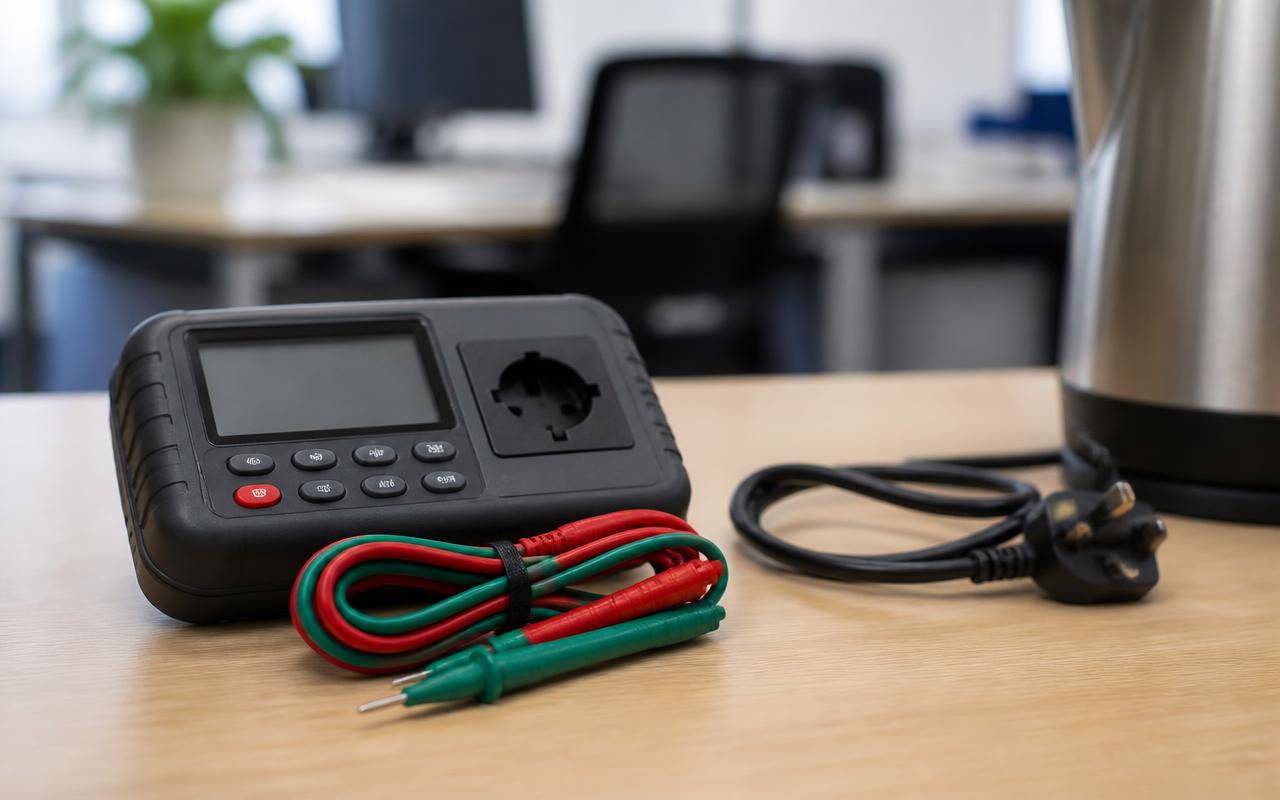
Portable appliance testing is the combined inspection and electrical testing of equipment that connects to the fixed installation by a plug or flexible cable: computers, kettles, extension leads, power tools, vacuum cleaners, kitchen equipment, IT hardware, workshop machinery on flex, and everything else that gets plugged in.
The majority of faults are found by formal visual inspection: damaged flexes, cracked plugs, incorrect fuses, poor cable clamping, signs of overheating, and unsuitable equipment for the environment. Electrical testing then confirms what the eye cannot see: earth continuity on Class I equipment, insulation resistance, polarity on leads, and functional operation.
The deliverable is not the sticker. It is the register: every item numbered, described, located, tested, dated and given a next-test date, with pass and fail results and the measured values behind them.
Who it is for
Employers of any size, who have a duty to maintain electrical work equipment in a safe condition.
Landlords supplying appliances with a let property, where the appliances they provide need to be safe and evidenced.
Offices, salons, gyms, cafés, restaurants, nurseries, schools and care settings with large volumes of small appliances.
Workshops, construction operations and hire fleets with 110V tools, transformers, leads and site equipment on shorter test intervals.
Event, AV and hospitality operators whose venues require evidence of testing before load-in.
When you need it
On the interval recorded for each class of equipment: high-risk portable tools far more often than a fixed office monitor.
Before an insurance renewal, audit or venue hire where evidence of testing will be requested.
After an office move, refit or the purchase of a batch of second-hand equipment.
When equipment is returned from hire, loan or a site where it has taken physical abuse.
When you have no register at all and cannot answer what has been tested and when.
Why it matters
PAT testing has a reputation problem, and it is deserved when it is done as a sticker exercise. A tester working at speed can put a green label on a lead without ever finding the cracked plug top or the 13A fuse in a 3A appliance, and the register that comes back is a list of numbers with no location and no description.
Done properly, it is one of the cheapest risk controls in a building. Most electrical incidents from portable equipment come from damage that a competent inspection catches in seconds: pinched flexes under desk legs, extension leads daisy-chained under load, kettle leads that have been trapped in a cupboard door for a year.
The register is what turns the exercise into evidence. Ours identifies each item, where it lives, what it is, its class, the tests applied, the measured values, the result and the retest date, so you can hand the file over and answer questions without searching a building for stickers.
The cost of leaving it
What happens when pat testing is put off
A damaged flex on a Class I appliance is a fault waiting for a coincidence. The earth conductor breaks inside the sheath where it flexes most, the appliance keeps working perfectly, and the protection that would have disconnected the supply if the casing became live is simply not there any more. Nothing outward changes until someone touches it.
Extension leads and multiway adaptors carry a disproportionate share of the risk in offices and homes, because they get loaded far beyond what anyone intended: heaters, kettles and IT stacked onto a four-way originally bought for two desk lamps, then run coiled up under a desk where the heat cannot escape. Fires from that specific scenario are common and entirely preventable by inspection.
Then there is the position you are in after an incident. If a portable appliance is implicated in a fire or an injury and you cannot produce evidence that your equipment was inspected and maintained, the conversation with your insurer and any enforcing authority becomes very difficult. A register costs a fraction of the exposure it covers.
Mistakes we are called in to correct
- Buying testing by the item at the lowest rate, which incentivises speed over inspection, and inspection is where most faults are found.
- Accepting a register with no item descriptions or locations, which is useless the moment you need to trace a specific failure.
- Testing everything on the same annual cycle, when a construction 110V tool and a boardroom projector plainly do not need the same interval.
- Ignoring extension leads and IEC leads because they are 'just cables'; they fail more often than the equipment they feed.
- Throwing away failed items without recording them, which leaves gaps in the register that look like items never tested.
Our process
How we deliver pat testing
- Step 1
Scope and asset count
We establish roughly how many items you have, what types, where they are, and whether an existing register can be carried forward or needs rebuilding from scratch. That produces a fixed quote and a realistic time on site.
- Step 2
Formal visual inspection
Every item is examined for damage, overheating, incorrect fusing, poor cable clamping, unsuitable use and environment. Items failing here are removed from service immediately and recorded, whether or not they would have passed the electrical tests.
- Step 3
Electrical testing
Earth continuity, insulation resistance, polarity on leads and functional checks are carried out with calibrated equipment, with the test regime matched to the class and type of each appliance rather than applied blanket-fashion.
- Step 4
Labelling and register
Each item is numbered and labelled with its result and retest date, and everything is compiled into an itemised asset register with descriptions, locations, measured values, pass/fail status and next-due dates.
- Step 5
Failures, repairs and retest dates
Failed items are listed with the reason. Where repair is sensible, a plug, a fuse, a lead replacement, we can put it right and retest on the spot rather than leave you an item short.
Benefits
What you get from working with us
Evidence you can produce instantly
An itemised register with locations and descriptions, so an auditor, insurer or safety officer gets a clear answer in seconds.
Genuine inspection, not sticker speed
Formal visual inspection is where most faults are found, and it is where we spend the time: damaged flexes, wrong fuses, overheating and misuse.
Sensible, risk-based intervals
Test frequencies matched to equipment type and environment, so you are not paying to test office monitors as often as site tools.
Minimal disruption
We work around occupied offices and trading hours, testing area by area so nobody loses a working day.
Repairs handled on the spot
Plugs, fuses and leads corrected and retested during the visit where it makes sense, so failures do not turn into equipment shortages.
One contractor for the whole picture
PAT alongside fixed wire testing, emergency lighting and fire alarm testing under a single accredited business, on complementary schedules.
In detail
PAT Testing explained in full
Equipment classes and what each test proves
Class I equipment relies on an earth connection for safety, so earth continuity between the plug pin and exposed metalwork is the critical measurement. Class II equipment is double-insulated and has no protective earth, so testing concentrates on insulation resistance and the integrity of the enclosure. IT and equipment with switched-mode supplies may need alternative or touch-current testing rather than a standard insulation test, to avoid damaging internal components.
Leads and extension leads are tested as items in their own right: earth continuity along the full length, insulation resistance and correct polarity, which catches the reverse-wired lead that a functional check would never reveal. Long leads and coiled leads get particular attention because that is where continuity and heat problems concentrate.
Setting intervals by risk
There is no single legal frequency for portable appliance testing. Intervals are set by risk: equipment type, how it is used, how often it is moved, the environment it works in, and the history of failures on similar items. Handheld tools on a construction site, 110V transformers and leads dragged across a working floor sit at one end. A desktop monitor that has not moved since installation sits at the other.
A sensible regime typically combines user checks before use, periodic formal visual inspection, and combined inspection and testing at longer intervals for lower-risk items. We set the intervals with you and record them per item so the register drives the schedule rather than someone's memory of last year's visit.
Sector differences that change the work
Offices are volume work: hundreds of low-risk items, IT-heavy, with the practical challenge being access to equipment under desks without disrupting people. Hospitality and catering shifts the balance towards heat, moisture and heavily used kitchen equipment where flexes take real punishment. Salons and gyms bring high-usage handheld equipment and wet environments.
Construction, engineering and workshops are the highest-risk category: 110V tools, transformers, site leads, and equipment that is dropped, run over and left outdoors. Intervals are short, failure rates are high, and the register earns its keep by tracking which items keep failing. Landlords sit at the other end, usually a handful of supplied appliances per property, but with the documentation mattering as much as the testing.
What we do with failures
Failures are recorded with the reason, not just a red sticker. A wrong fuse, a damaged plug top, a poorly clamped flex and a broken earth are four very different findings with four different implications for the rest of your estate, and a register that distinguishes them tells you whether you have an equipment problem or a handling problem.
Where the fix is simple and worth doing, a plug, a fuse, a replacement lead, we can carry it out during the visit and retest, so you keep the equipment. Where the item is beyond economical repair, we record it as removed from service so there is no gap in the register that looks like an untested asset.
FAQs
PAT Testing: common questions
How much does PAT testing cost?
+It depends on the number and type of items, how spread out they are, and whether we are rebuilding a register or updating one. We quote per site rather than advertise a per-item rate that only works at volume: the quote is free and carries no obligation, and we accept BACS and all major credit and debit cards.
How often should appliances be tested?
+There is no single legal interval. Frequency is set by risk: handheld tools in a workshop or on site need testing far more often than a monitor that never moves. We agree intervals by equipment type and environment and record the next-due date against every item in the register.
Is PAT testing a legal requirement?
+The law requires electrical equipment to be maintained in a safe condition; it does not name a specific test or interval. Inspection and testing on a risk-based schedule, with records, is the recognised way to demonstrate you have done that, which is why insurers and auditors ask for the register.
How long will testing take and will it disrupt us?
+We work area by area around occupied offices and trading hours, and most items take under a minute each. We will give you an expected time on site with the quote, and we can work outside core hours where the environment demands it.
What do I actually receive afterwards?
+An itemised asset register listing every item with its description, location, class, tests applied, measured values, pass or fail result and next-due date, plus a clear list of failures with the reason for each. Items are labelled on site as well.
What happens to items that fail?
+They are removed from service and recorded with the reason. Where the fault is a plug, fuse, or lead we can usually repair and retest during the visit so you keep the equipment; where an item is beyond economical repair we record it as withdrawn so the register stays complete.
Do you test IT equipment and extension leads?
+Yes. IT equipment is tested with a method suited to switched-mode supplies rather than a blanket insulation test that could damage it, and extension leads and IEC leads are tested as items in their own right; they fail more often than the equipment they feed.
Can you do PAT testing alongside our other electrical testing?
+Yes, and it is usually the efficient way to do it. We deliver fixed wire testing, emergency lighting testing, fire alarm testing and thermal imaging as well, so one accredited contractor holds the full maintenance picture for the site.
Do you cover my area?
+We cover Leeds, Wakefield, Harrogate, York, Doncaster, Sheffield, Hull and Manchester from our base in Leeds. Call 0113 418 2086 and we will confirm your postcode and the likely time on site.
Accreditations
Independently assessed,
not self-certified
NAPIT registered, CHAS accredited, SafeContractor approved and MCS registered. City & Guilds 2391 Inspection & Testing and 18th Edition held. Fully insured: details available on request.



Get a PAT register you can actually use
Tell us roughly how many items you have and where they are. We will quote against the real count, inspect properly, and leave you with an itemised register and clear retest dates.
Reviews
Rated 4.9 out of 5
by 105 local clients
Landlords, homeowners, letting agents, offices and industrial sites. Read them in full on Google.
“Harry is reliable, trustworthy and professional. He knows what he is doing and keeps records of the work that he has done and always responds in a timely manner.”
“I needed an EICR on my rental property and Pyramid were there the next day. I cannot recommend these guys enough. 5 stars isn't enough!”
“Harry even went the extra mile and worked on a Sunday at no additional charge at late notice to complete the work as we needed the EICR to complete our mortgage. Very quick turnaround from initial contact, through to survey, through to remedial works being completed.”
“Called Harry after being let down by another company who failed to show up. Came round within an hour as promised. The work was carried out to a very high standard and the price was very reasonable.”
“I recommend Harry and his team to all my clients for any electrical needs. My clients always compliment him on his work each time and how reliable he has been.”
“I sought 2 other quotes from other reputable businesses, however, I found Harry's quote to be the most competitive. His pricing was transparent and I would not hesitate to recommend Pyramid Services to others.”
“We have used Harry and Joe numerous times over several years, for different size projects, both inside and outside. They have converted all our offices to LED lighting.”
Request a quote
Book your electrical testing
with one accountable specialist
Tell us the premises and what you need certified. We will confirm scope and give you a free, no-obligation quote, then test, certify and put right anything that fails.
- Call
- 0113 418 2086
- Address
- Ste 1, Regent, Regent St, Leeds LS9 7RD