

EICRs
EICR Testingin Leeds & West YorkshireCertified, Coded and Corrected
A full Electrical Installation Condition Report on your property, booked around your tenants or trading hours, with every C1, C2 and FI observation explained in plain English and put right by the same engineers who found it.
Rated 4.9 from 105 Google reviews · NAPIT registered · Remedials completed in-house
- 17 years
- In the electrical trade
- 4.9 / 5
- From 105 Google reviews
- NAPIT
- Registered and independently assessed
- 2391
- City & Guilds Inspection & Testing held
- In-house
- Remedial works and re-certification
Service overview
EICRs (Electrical Installation Condition Reports)
What it is
An EICR is a formal inspection and test of the fixed electrical installation in a property: the consumer unit or distribution board, the circuits running from it, the accessories on those circuits, the earthing and bonding arrangements, and the protective devices that are supposed to disconnect the supply when something goes wrong.
The inspection combines a physical examination of the installation with dead and live testing: continuity of protective conductors, insulation resistance, polarity, earth fault loop impedance and RCD operation. Every result is recorded against the circuit it came from, so the report is a measured record of the installation rather than an opinion about it.
The output is a written Electrical Installation Condition Report declaring the installation either satisfactory or unsatisfactory, with each departure from the current wiring regulations coded C1 (danger present), C2 (potentially dangerous), C3 (improvement recommended) or FI (further investigation required). A single C1, C2 or FI makes the report unsatisfactory until it is resolved.
Who it is for
Private landlords and portfolio landlords who must hold a valid report for every rented dwelling and supply a copy to tenants and, on request, to the local authority.
Letting and managing agents who need certification turned around between tenancies without chasing two separate contractors for the test and the remedials.
Homeowners buying, selling or remortgaging, where a lender, surveyor or solicitor has asked for evidence that the installation is safe.
Business owners, facilities managers and trustees responsible for offices, shops, salons, workshops,village halls, schools and places of worship who need documented electrical safety for insurance and duty-of-care purposes.
When you need it
At change of tenancy, and at least every five years for a rented dwelling.
Before a sale or purchase completes, when the installation is of unknown age or has visibly been altered.
After an extension, loft conversion, garden office or any works that added circuits to an existing board.
When an insurer, lender, mortgage valuer or local authority has asked for one in writing.
When the installation is showing symptoms: repeated tripping, warm accessories, scorching, flickering, or a board full of rewireable fuses.
Why it matters
The value of an EICR is entirely in the competence of the person carrying it out. A rushed visual walk-round that skips live testing produces a certificate with no evidence behind it, and that is exactly the document that fails scrutiny when an insurer investigates a claim or a local authority requests the report.
Our inspections are carried out by time-served engineers holding City & Guilds 2391 Inspection & Testing and the 18th Edition, under a business that is NAPIT registered, CHAS accredited, SafeContractor approved and MCS registered. Every schedule of test results is completed with actual measured values, and every observation is photographed and explained so you know precisely what you are being asked to spend money on.
We also correct what we find. Where a report comes back unsatisfactory, our own engineers carry out the remedial works and re-issue the certification; you are not left holding a coded list and ringing round for a second contractor while a tenancy or a completion date runs down.
The cost of leaving it
What happens when eicrs is put off
An unsatisfactory installation does not stay still. Loose terminations heat up under load, the heat degrades the insulation around them, and the degraded insulation reduces the very resistance that keeps current inside the conductor. That is a fault that gets worse every day the circuit is used, and it does not announce itself until something scorches, trips repeatedly or ignites.
The paperwork risk is just as real as the physical one. A rented dwelling without a valid report exposes the landlord to enforcement action from the local authority and to remedial notices with deadlines attached. An insurer presented with a claim on a commercial property will ask for the current condition report, and a missing or expired one is a straightforward reason to question the claim. A sale can be held at the point of exchange because a lender's surveyor has flagged an installation nobody has certified in twenty years.
The cost curve is the part people miss. A C2 observation found early is usually a termination, an accessory, a length of cable or a missing bond. Left alone, the same fault takes out a protective device, damages equipment downstream, or spreads into a section of wiring that then needs replacing rather than repairing. Testing on a planned cycle keeps you in the cheap end of that curve.
Mistakes we are called in to correct
- Treating the cheapest quote as comparable: a fixed-price EICR that samples a handful of circuits is not the same inspection as one that tests the installation properly and records the values.
- Accepting a report with blank or duplicated test results, which is the clearest sign the testing was not carried out circuit by circuit.
- Booking the inspection and then hunting separately for someone to fix the C2s, which doubles the coordination and often costs more than having one contractor do both.
- Assuming a five-year-old installation cannot fail: alterations by other trades, DIY additions and damaged cabling account for a large share of observations.
- Leaving certification until the week a tenancy starts or a sale completes, which removes any margin for remedial works.
Our process
How we deliver eicrs
- Step 1
Survey and scope
We establish the size and age of the installation, how the premises are used, how many circuits and boards are involved, and what access looks like. That gives you a fixed quote against real scope rather than a headline price that changes once we are on site.
- Step 2
Inspection
A physical examination of the intake, earthing and bonding, distribution equipment, accessories and visible cabling, identifying damage, deterioration, unsuitable equipment and departures from the current regulations before any testing begins.
- Step 3
Dead and live testing
Continuity, insulation resistance, polarity, earth fault loop impedance and RCD disconnection times are measured circuit by circuit with calibrated instruments, and every value is recorded on the schedule of test results.
- Step 4
Coding and reporting
Observations are coded C1, C2, C3 or FI and written up with photographs. You get a clear verbal summary on the day and the full report afterwards, including the recommended date of the next inspection.
- Step 5
Remedials and re-certification
Where the report is unsatisfactory, we quote the corrective work, carry it out with our own engineers and issue updated certification, so the file you hand to a tenant, insurer or lender is complete and satisfactory.
Benefits
What you get from working with us
Compliance evidence that stands up
A fully completed report with measured values, coded observations and photographs: the document an insurer, local authority or lender actually accepts, not a one-page summary.
One contractor, start to finish
Inspection, remedial works and re-certification handled by the same team, so nothing sits in the gap between two companies blaming each other's scope.
Faults found before they cost you
Loose terminations, degraded insulation and overloaded circuits identified while they are still a repair rather than a rewire or an equipment failure.
Tenancies and sales kept on schedule
Certification turned around promptly and remedials booked immediately, so a coded observation does not stall a move-in date or a completion.
Priced against your actual installation
We quote after understanding the property, so the figure you approve is the figure you pay. Free quotes, no obligation, BACS and all major credit and debit cards accepted.
Work you can point at
Rated 4.9 from 105 Google reviews by landlords, homeowners, letting agents and commercial clients across Yorkshire, with repeat clients going back years.
In detail
EICRs explained in full
What gets tested, and with what
Testing is carried out with calibrated multifunction instruments, and the sequence matters. Dead tests come first: continuity of protective conductors and ring final circuit conductors, insulation resistance between live conductors and to earth, and polarity throughout. Only once the installation has passed those do we energise and carry out live testing: earth fault loop impedance at the origin and at circuit extremities, prospective fault current, and RCD trip timing at half, one and five times rated residual current, including the instantaneous test.
Every reading is written against its circuit on the schedule of test results, alongside the conductor sizes, protective device types and ratings, and the reference method for the installed cabling. That schedule is what makes the report auditable years later, and it is the part most often left blank on cheap certificates.
Understanding the codes
C1 means danger is present and there is a risk of injury: exposed live parts, for example. We make it safe immediately, with your permission, before leaving site. C2 means potentially dangerous: no immediate risk while everything stays as it is, but a fault or a moment of contact would create one. Missing earthing to a metallic accessory or an absent main protective bond are classic C2s.
C3 is an improvement recommendation. It does not make a report unsatisfactory and does not have to be actioned, though it is often worth doing while the board is open. FI means further investigation is required, usually because a symptom was found that cannot be diagnosed within the scope of the inspection: an unidentified circuit, a concealed junction, or a result that does not match the installed cable. FI makes a report unsatisfactory until the investigation is complete.
Domestic, commercial and industrial differences
A domestic EICR typically covers a single-phase supply, one consumer unit and somewhere between six and sixteen circuits, and can usually be completed in a single visit with the power off in stages. Landlord reports follow the same technical scope but come with the documentation requirements attached to a tenancy.
Commercial premises bring three-phase supplies, sub-distribution boards, emergency lighting and fire alarm interfaces, and the need to phase testing around trading hours. Industrial sites add machinery, motor circuits, control panels, higher fault levels and sometimes hazardous areas, where isolation has to be planned with production rather than around it. On larger installations, inspection and testing is commonly sampled and phased across an agreed programme rather than completed in one shutdown: an approach normally handled under a fixed wire testing schedule.
Age of installation changes the work as much as the sector. Rewireable fuse boards, rubber or lead-sheathed cabling, no RCD protection on socket circuits, and boards without main switches all push an installation towards an unsatisfactory result, and the honest conversation on those properties is often about upgrade rather than repair.
Frequency and what drives it
Rented dwellings are generally inspected at least every five years or at change of tenancy. Owner-occupied homes are commonly recommended at ten years, and more often where the installation is older or has been altered. Offices, shops and similar commercial premises are typically every five years, and industrial premises every three, with shorter intervals for construction sites, agricultural and horticultural premises, swimming pools, caravan parks and public entertainment venues.
Those are starting points, not rules. The correct interval depends on the type of installation, its use, the external influences it is exposed to, the frequency of maintenance, and the age and condition found at the last inspection. We set and record the recommended next inspection date on the certificate for your specific installation.
FAQs
EICRs: common questions
How much does an EICR cost in Leeds?
+We do not publish a headline price, because the number of circuits, the age of the installation, the access and the condition change the work involved on every property. We quote against your actual installation after a short conversation about the premises, and the quote is free and carries no obligation. We accept BACS and all major credit and debit cards.
How long does an EICR take?
+A typical two- or three-bedroom home with a single consumer unit is usually a half day. Larger homes, properties with multiple boards, and commercial premises take longer and are often phased so that testing does not shut the whole site down at once. We confirm the expected time when we quote, so you can plan around tenants or trading hours.
Will my power be off during the inspection?
+Yes, in stages. Dead testing requires circuits to be isolated, so supplies come off circuit by circuit rather than all day. In occupied commercial premises we plan the sequence with you in advance, and we can work outside trading hours where the site needs it.
What happens if the report comes back unsatisfactory?
+We explain every C1, C2 and FI observation, what caused it and what correcting it involves, and quote the remedial work. Our own engineers then carry out the repairs and issue updated certification, so you finish with a satisfactory report rather than a list of problems and a second contractor to find.
How long is an EICR valid for?
+The report states the recommended date of the next inspection, which is set by the inspector based on the type of installation and its condition. For rented dwellings that is generally no more than five years, or sooner at change of tenancy. The report is a snapshot of condition on the day, so significant alterations before that date warrant a fresh look.
Do you carry out the remedial works as well?
+Yes, including remedials on reports issued by other contractors. We will review the coding, confirm what genuinely needs doing, correct it and re-certify. Clients regularly come to us after being handed an unsatisfactory report with no realistic route to fixing it.
Can you attend urgently for a sale or tenancy deadline?
+We take deadline-driven work seriously and will tell you honestly what we can do when you call. Our reviews include a landlord who needed an EICR on a rental property and had us there the next day, and a client whose remedial works were completed on a Sunday at no additional charge to hit a mortgage completion.
Are you qualified and insured to issue the report?
+Pyramid Services is NAPIT registered, CHAS accredited, SafeContractor approved and MCS registered, and our engineers hold City & Guilds 2391 Inspection & Testing and the 18th Edition. We are fully insured, and details are available on request.
Do you cover my area?
+We work across Leeds, Wakefield, Harrogate, York, Doncaster, Sheffield, Hull and Manchester from our base in Leeds. Call 0113 418 2086 and we will confirm coverage for your postcode straight away.
Accreditations
Independently assessed,
not self-certified
NAPIT registered, CHAS accredited, SafeContractor approved and MCS registered. City & Guilds 2391 Inspection & Testing and 18th Edition held. Fully insured: details available on request.



Get a satisfactory EICR, and the remedials done with it
Tell us the property and what you need certified. We will quote against the actual scope, test properly, and put right anything that fails so your file is complete.
Reviews
Rated 4.9 out of 5
by 105 local clients
Landlords, homeowners, letting agents, offices and industrial sites. Read them in full on Google.
“Harry is reliable, trustworthy and professional. He knows what he is doing and keeps records of the work that he has done and always responds in a timely manner.”
“I needed an EICR on my rental property and Pyramid were there the next day. I cannot recommend these guys enough. 5 stars isn't enough!”
“Harry even went the extra mile and worked on a Sunday at no additional charge at late notice to complete the work as we needed the EICR to complete our mortgage. Very quick turnaround from initial contact, through to survey, through to remedial works being completed.”
“Called Harry after being let down by another company who failed to show up. Came round within an hour as promised. The work was carried out to a very high standard and the price was very reasonable.”
“I recommend Harry and his team to all my clients for any electrical needs. My clients always compliment him on his work each time and how reliable he has been.”
“I sought 2 other quotes from other reputable businesses, however, I found Harry's quote to be the most competitive. His pricing was transparent and I would not hesitate to recommend Pyramid Services to others.”
“We have used Harry and Joe numerous times over several years, for different size projects, both inside and outside. They have converted all our offices to LED lighting.”
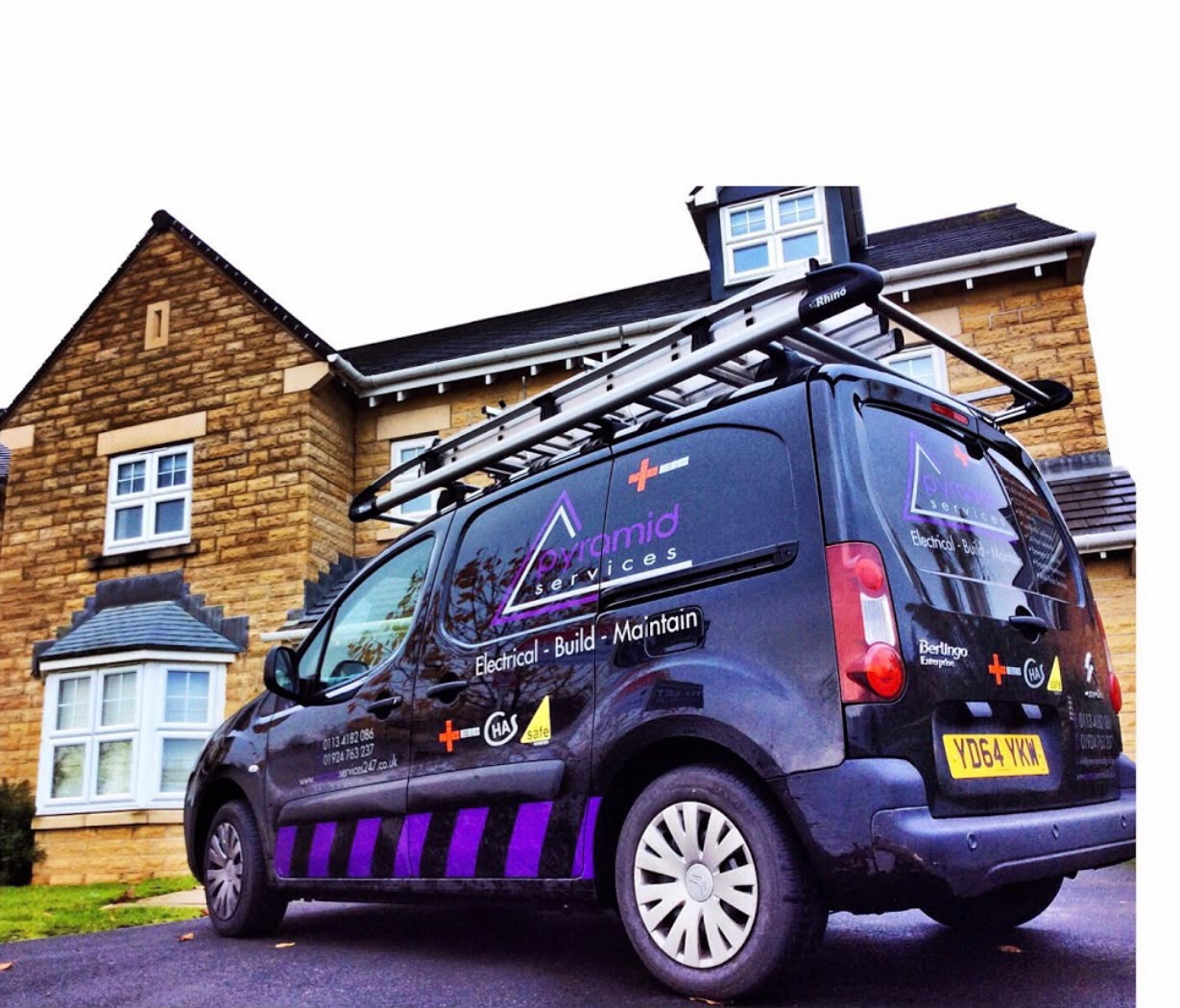
Request a quote
Book your electrical testing
with one accountable specialist
Tell us the premises and what you need certified. We will confirm scope and give you a free, no-obligation quote, then test, certify and put right anything that fails.
- Call
- 0113 418 2086
- Address
- Ste 1, Regent, Regent St, Leeds LS9 7RD