
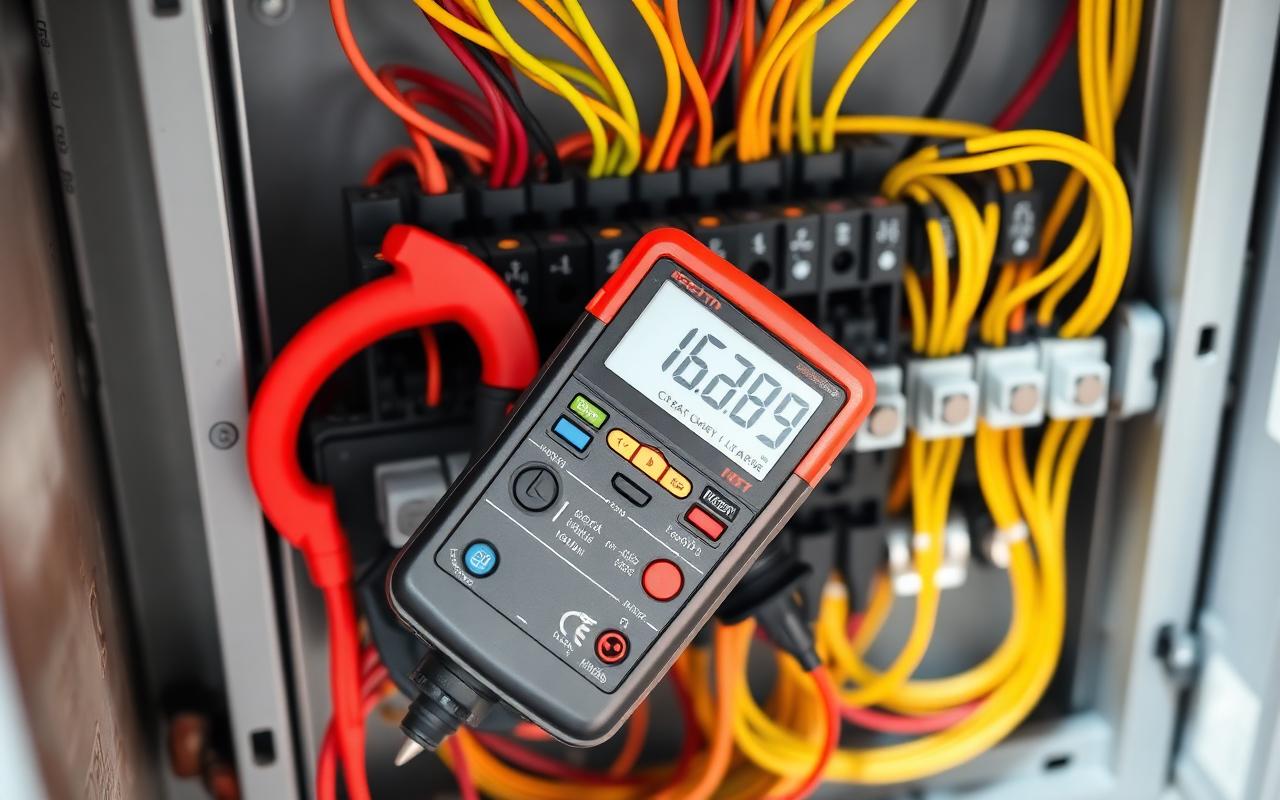
Fault Finding
Electrical Fault Findingin Leeds, Cause Identified,Not Guessed At
Systematic diagnosis of tripping breakers, earth faults, intermittent failures and dead circuits, using proper testing rather than trial-and-error replacement, so you pay for the fault to be found once and fixed properly.
17 years in the trade · Fully insured · 4.9 from 105 Google reviews
- 2391
- City & Guilds Inspection & Testing held
- Systematic
- Measured diagnosis, not part swapping
- 17 years
- In the electrical trade
- Insured
- Fully insured: details on request
- 4.9 / 5
- From 105 Google reviews
Service overview
Fault finding
What it is
Fault finding is the structured process of locating the cause of an electrical problem: which circuit, which section, which component, and why. It combines symptom analysis, circuit isolation and division, and instrument testing, insulation resistance, continuity, loop impedance, RCD behaviour and load measurement, to narrow the fault down to a physical location.
The problems it addresses are the familiar ones: an RCD that trips at random, a breaker that will not stay in, sockets or lights dead on part of a circuit, intermittent failures that clear before anyone arrives, burning smells, buzzing accessories, and equipment failing repeatedly for no obvious reason.
The result is a diagnosis with evidence behind it, a clear explanation of what caused it, and a repair: carried out on the visit where parts and access allow.
Who it is for
Homeowners with a board that keeps tripping, a dead ring final circuit, or lights failing on one part of the house.
Landlords and agents responding to tenant reports where a quick, definitive answer avoids repeat visits.
Businesses whose equipment or lighting fails intermittently and whose previous contractor replaced parts without solving it.
Industrial sites with nuisance tripping on machine circuits, drives and control panels affecting production.
Anyone who has already had two contractors out and still has the same fault.
When you need it
As soon as a protective device operates more than once without an obvious cause: repeated resetting is not a fix.
When there is any smell of burning, discolouration, buzzing or heat around accessories or the board.
When an EICR has returned an FI code requiring further investigation.
When equipment or lamps fail far sooner than they should, which often indicates a supply-side problem.
Immediately, where a fault has left circuits dead in a rented property or a trading premises.
Why it matters
Fault finding is where the difference between a tester and a guesser shows most clearly. Anyone can replace an RCD. Finding the degraded section of buried cable causing 20mA of leakage on a Tuesday afternoon when the heating comes on requires instruments, method and the discipline to divide the circuit and measure rather than assume.
The trial-and-error approach costs more than it looks. Each replaced component is parts and labour, the fault persists, and by the third visit the customer has paid for a diagnosis several times over without receiving one. Worse, intermittent faults get declared solved because they happened not to recur that week.
Our approach is to measure. Circuits are divided and tested, leakage is quantified, and the fault is located to a physical point before anything is replaced. When the cause is genuinely an appliance rather than the installation, we say so: that is a cheaper answer for you and an honest one.
The cost of leaving it
What happens when fault finding is put off
Every recurring electrical fault is a fault that is still there. An RCD tripping intermittently is doing exactly what it was designed to do: it has detected current leaking to earth. Resetting it acknowledges the warning and ignores it. The leakage path, damaged insulation, water ingress, a failing element, does not improve on its own, and its usual trajectory is towards a short circuit, an overheating cable or a shock.
Intermittent faults escalate in a specific and dangerous way. A loose termination arcs, and every arc carbonises the surrounding insulation slightly further. Carbon conducts, so the fault path improves as the damage worsens, until the connection fails completely, commonly with enough heat to ignite the accessory or the enclosure. Buzzing sockets and warm switch plates are the audible and tactile warnings before that point.
Commercially, unresolved faults become expensive in downtime rather than repair cost. A machine circuit that trips unpredictably takes out production runs. A shop with a dead lighting circuit trades badly. And an EICR marked FI keeps a report unsatisfactory until someone actually investigates, which stalls tenancies and sales just as effectively as a C2.
Mistakes we are called in to correct
- Repeatedly resetting a tripping device and treating each reset as a solution.
- Replacing the RCD, the breaker or the accessory before measuring anything, then repeating the exercise when the fault returns.
- Disconnecting or bypassing protection so the circuit stays on, which removes the safety function and leaves the fault live.
- Describing the symptom vaguely: the time of day, weather conditions and which appliances are running are often the fastest route to the cause.
- Assuming a new fault must be caused by the last thing installed, when it is frequently an older circuit finally deteriorating.
Our process
How we deliver fault finding
- Step 1
Symptom analysis
We take the history: what happens, when, what is running at the time, what changed recently, and whether it correlates with weather, heating, machinery or occupancy. That alone often halves the search area.
- Step 2
Isolation and circuit division
Circuits are isolated and progressively divided so the fault is confined to a defined section rather than a whole installation, which is what makes intermittent faults findable at all.
- Step 3
Instrument testing
Insulation resistance, continuity, polarity, loop impedance, leakage current and RCD behaviour are measured with calibrated equipment, and the readings tell us the type of fault as well as its location.
- Step 4
Physical location and explanation
We locate the fault physically, the accessory, the junction, the buried section, the appliance, and explain what caused it and what the repair involves, with the measurements to back it up.
- Step 5
Repair, re-test and verification
The repair is carried out, the circuit re-tested to confirm the fault is genuinely cleared, and certification issued for the work so there is a record of what was found and what was done.
Benefits
What you get from working with us
Paid once, fixed once
Measurement-led diagnosis instead of sequential part replacement, so you are not funding somebody's process of elimination.
Intermittent faults actually located
Circuit division and leakage measurement find the faults that clear before anyone arrives and reappear the following week.
Protection stays in place
We fix the cause rather than disable the RCD, so the installation keeps the safety function that flagged the problem.
FI codes closed out
Further investigation observations on an EICR resolved and documented, so the report can be re-issued satisfactory.
Honest answers about appliances
Where the fault is a washing machine or an immersion element rather than the installation, we tell you: the cheaper answer, and the true one.
Downtime kept short
Systematic method means faster resolution on commercial and industrial circuits where every hour of stoppage costs.
In detail
Fault Finding explained in full
The main fault types and how they present
Earth faults show as RCD tripping, and the character of the trip is informative: immediate on energising suggests a hard fault, while random tripping under certain conditions suggests accumulated leakage or moisture ingress. Measuring standing leakage on each circuit with a clamp meter separates a genuine fault from an installation where many appliances each contribute a little and collectively cross the threshold.
Short circuits and overloads operate the overcurrent device instead, and distinguishing them matters: a short circuit is a defect to be found, whereas an overload is a design or usage problem that will recur until the load is changed or the circuit is upgraded. Open circuits, dead sockets or lights part-way round a circuit, are usually a failed termination, and on ring finals the diagnosis is a continuity exercise around the ring.
High-resistance faults are the most insidious. The circuit works, nothing trips, but a joint runs hot. They present as heat discolouration, buzzing, flickering lights, and premature failure of connected equipment, and they are found through loop impedance measurement, load testing and thermal imaging rather than by looking at the board.
Techniques and instruments
Insulation resistance testing at the correct test voltage identifies degraded insulation between conductors and to earth, and testing circuit sections separately localises it. Clamp meters measure real-world leakage on live circuits without isolation, which is the primary tool for nuisance tripping. Loop impedance measurement identifies high-resistance connections and confirms disconnection times.
Beyond the standard set, cable tracing and detection locates buried runs and junctions before anyone opens a wall, and thermal imaging finds hot joints under load in boards and panels. On industrial systems, insulation testing must account for drives and electronic equipment, which are disconnected or bypassed to avoid damage: a step that distinguishes competent diagnosis from expensive collateral damage.
Domestic, commercial and industrial differences
Domestic fault finding is dominated by moisture and mechanical damage: outdoor sockets and garden supplies, shower and immersion elements, nails and screws through buried cables, and old lighting circuits with degraded insulation. Accumulated leakage across many appliances is the common cause of the RCD that trips 'for no reason' on a whole-board arrangement.
Commercial premises add scale and access constraints: suspended ceilings, occupied areas, IT loads that cannot be dropped, and multi-tenanted distribution where the fault may not be in your part of the building. Diagnosis has to be planned around trading hours.
Industrial fault finding brings three-phase supplies, motors, drives, control circuits and machinery. Faults are often load-dependent, appearing only when a machine runs, and diagnosis requires the process to be running at the right moment. It also means working with production, and clearly separating faults in the fixed installation from faults within work equipment.
What we do when the fault is not in the installation
A significant share of call-outs end with the installation exonerated and an appliance identified: a washing machine heating element, an immersion heater, a failing extractor, or a piece of equipment with degraded insulation. We identify the item, demonstrate the measurement, and tell you plainly.
Where the fault sits in machinery or work equipment on an industrial site, we mark the boundary clearly, so responsibility for repair is not disputed between the electrical contractor and the maintenance provider. Being straight about the boundary is quicker and cheaper for the client than defending an invoice for work outside it.
FAQs
Fault Finding: common questions
How much does fault finding cost?
+Diagnosis is charged for the time and testing it takes, because nobody can honestly quote a fixed price for locating an unknown fault. We agree an approach and a budget with you before starting, tell you what we find, and quote the repair separately. Free quotes on the repair, BACS and all major cards accepted.
How long does it take to find a fault?
+Straightforward faults, a dead ring, an obvious earth fault, are often located within an hour or two. Intermittent faults that depend on weather, load or time of day take longer, and we will tell you honestly how we intend to narrow it down rather than open-endedly charging for guesswork.
Why does my RCD keep tripping?
+Because it is detecting current leaking to earth. That is usually degraded insulation, water ingress, a faulty appliance, or accumulated leakage from many appliances on the same device. Measuring the leakage per circuit identifies which, and it is not solved by resetting it.
Can you find a fault that has stopped happening?
+Often, yes. Intermittent faults leave measurable evidence: marginal insulation values, elevated leakage, high-resistance joints and heat signatures. We test for the conditions that produce the fault rather than waiting for it to reappear.
Will you repair the fault on the same visit?
+Where access and parts allow, yes. Most common repairs, terminations, accessories, damaged sections of cable, protective devices, are completed during the visit. Larger works, such as replacing a run of buried cable, are quoted and booked.
Can you deal with an FI code on my EICR?
+Yes. Further investigation observations are exactly this work: locating and explaining the underlying issue so the observation can be resolved and the report re-issued as satisfactory, whether the original report was ours or another contractor's.
Do you attend urgently?
+We prioritise faults that have left a property or premises without power and tell you honestly what we can do when you call. Our reviews include a customer let down by another company who had us on site within the hour as promised.
Can you find faults on three-phase and machine circuits?
+Yes. Industrial fault finding on motors, drives, control panels and machine supplies is core work for us, including load-dependent faults that only appear while the process is running.
Which areas do you cover?
+Leeds, Wakefield, Harrogate, York, Doncaster, Sheffield, Hull and Manchester from our base in Leeds. Call 0113 418 2086 and describe the symptom; it often shortens the visit.
Accreditations
Independently assessed,
not self-certified
NAPIT registered, CHAS accredited, SafeContractor approved and MCS registered. City & Guilds 2391 Inspection & Testing and 18th Edition held. Fully insured: details available on request.



Stop resetting it. Get the cause found and fixed.
Tell us what happens and when. We will diagnose it with instruments rather than guesswork, repair it, and re-test to prove it is genuinely cleared.
Reviews
Rated 4.9 out of 5
by 105 local clients
Landlords, homeowners, letting agents, offices and industrial sites. Read them in full on Google.
“Harry is reliable, trustworthy and professional. He knows what he is doing and keeps records of the work that he has done and always responds in a timely manner.”
“I needed an EICR on my rental property and Pyramid were there the next day. I cannot recommend these guys enough. 5 stars isn't enough!”
“Harry even went the extra mile and worked on a Sunday at no additional charge at late notice to complete the work as we needed the EICR to complete our mortgage. Very quick turnaround from initial contact, through to survey, through to remedial works being completed.”
“Called Harry after being let down by another company who failed to show up. Came round within an hour as promised. The work was carried out to a very high standard and the price was very reasonable.”
“I recommend Harry and his team to all my clients for any electrical needs. My clients always compliment him on his work each time and how reliable he has been.”
“I sought 2 other quotes from other reputable businesses, however, I found Harry's quote to be the most competitive. His pricing was transparent and I would not hesitate to recommend Pyramid Services to others.”
“We have used Harry and Joe numerous times over several years, for different size projects, both inside and outside. They have converted all our offices to LED lighting.”
Request a quote
Book your electrical testing
with one accountable specialist
Tell us the premises and what you need certified. We will confirm scope and give you a free, no-obligation quote, then test, certify and put right anything that fails.
- Call
- 0113 418 2086
- Address
- Ste 1, Regent, Regent St, Leeds LS9 7RD