
Consumer Unit Work
Consumer Unit Upgradesin Leeds: Modern Protection,Certified and Tested
Replace a rewireable or unprotected board with a modern consumer unit that gives every circuit the right protection, clears the C2 observations holding up your report, and comes fully tested and certified.
NAPIT registered · Remedials and re-certification in-house · 4.9 from 105 reviews
- NAPIT
- Registered and independently assessed
- Certified
- Installation certificate and test results
- 17 years
- In the electrical trade
- Insured
- Fully insured: details on request
- 4.9 / 5
- From 105 Google reviews
Service overview
Consumer unit work
What it is
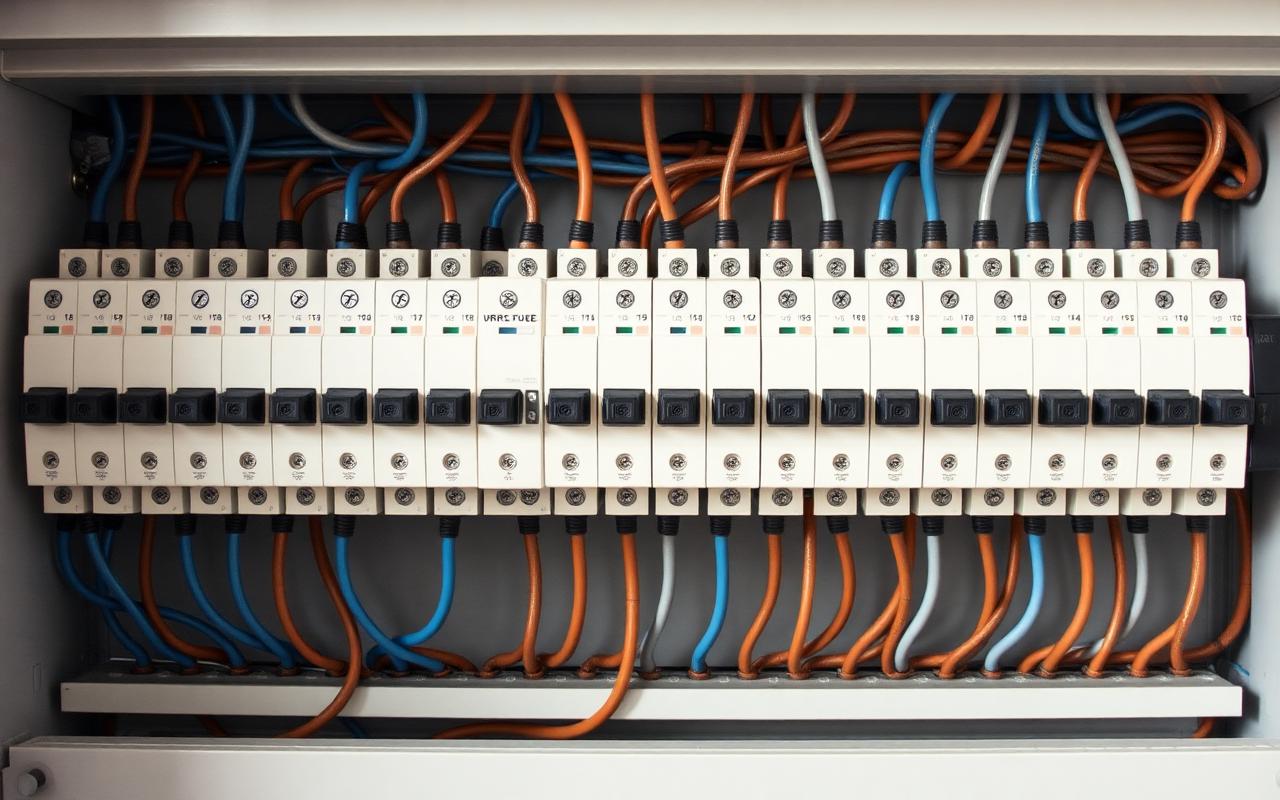
A consumer unit upgrade replaces the board that distributes and protects every circuit in the property. Modern units combine a main switch, overcurrent protection for each circuit, residual current protection to disconnect on earth faults, and increasingly surge protection and arc fault detection where these are appropriate.
The work is more than swapping an enclosure. Every circuit is tested before and after, existing wiring is inspected at the point of connection, earthing and main protective bonding are verified and upgraded where undersized, and the installation is certified on completion with a full schedule of test results.
For commercial and industrial premises, the equivalent work is distribution board replacement or refurbishment, which brings phasing, discrimination and shutdown planning into the same job.
Who it is for
Homeowners with a rewireable fuse board, a board with no RCD protection, or one that trips repeatedly.
Landlords whose EICR has returned unsatisfactory because the board cannot provide the protection now required.
Buyers and sellers whose survey or lender has flagged the electrical installation.
Businesses with distribution boards that are full, obsolete, damaged or no longer matched to how the site is loaded.
Anyone adding a significant load, EV charge point, electric shower, heat pump, solar PV or battery storage, to a board with no capacity.
When you need it
When the existing board uses rewireable fuses or has no RCD protection on socket and cable-buried circuits.
When an EICR has coded the board or the absence of protection as C2.
Before or during the addition of a heavy new circuit, so the work is done once rather than twice.
When the board is full, damaged, showing heat discolouration, or has been added to repeatedly by different trades.
When protective devices trip without an identifiable cause and the board itself is the suspect.
Why it matters
The board is the only part of an installation whose entire job is to disconnect the supply when something dangerous happens. A rewireable fuse offers overcurrent protection and nothing else, no residual current detection, so an earth fault through a person is simply not something the board can respond to quickly enough to matter.
Modern protection changes the outcomes of the most common domestic accidents: a nail through a buried cable, a damaged flex on a garden tool, water in an outdoor socket, a failed appliance element. RCD protection disconnects those in milliseconds. That is the whole argument for the upgrade, and it is worth more than any of the cosmetic differences between old and new boards.
Doing it properly means testing the circuits, not just replacing the box. We frequently find pre-existing faults, degraded insulation, borrowed neutrals, undersized bonding, that only reveal themselves when RCD protection is added, and finding them during the work is the difference between a finished job and a board that trips on the first day.
The cost of leaving it
What happens when consumer unit work is put off
Old boards fail slowly and then suddenly. Rewireable fuse carriers loosen, contacts oxidise, and the resulting resistance heats the board from inside, which is why heat discolouration around a fuse way is a serious finding rather than a cosmetic one. The failure mode from there is a burnt board, a dead property and an emergency call-out at whatever rate is available that day.
The compliance consequence is more immediate for landlords and sellers. A board without RCD protection generates C2 observations on an EICR, and a C2 makes the report unsatisfactory. That stops a tenancy, delays a completion and puts the landlord inside a 28-day remedial window whether the budget was planned or not.
The mistake that costs most is the partial fix: replacing the board without testing the circuits, or fitting a new unit onto an installation whose bonding is undersized and whose wiring has degraded insulation. The RCDs then trip repeatedly, and the temptation is to blame the new board and start disabling protection, which leaves the property less safe than before the money was spent.
Mistakes we are called in to correct
- Treating the upgrade as a like-for-like swap without testing the existing circuits first, then discovering pre-existing faults after the new protection is live.
- Leaving main protective bonding to gas and water undersized or absent, which undermines the whole protective arrangement.
- Choosing a board with no spare capacity, so the next circuit means another upgrade.
- Accepting the work without an installation certificate and schedule of test results.
- Disabling or bypassing RCD protection to stop nuisance tripping instead of finding the fault causing it.
Our process
How we deliver consumer unit work
- Step 1
Survey and pre-test
We inspect the existing board, supply arrangement, earthing and bonding, and test the circuits before quoting, so pre-existing faults are known upfront rather than discovered halfway through the change.
- Step 2
Specification and quote
Board size and spare capacity, protective device types, surge protection and any bonding upgrades are specified against your installation, and you get a fixed price and a realistic time on site.
- Step 3
Installation
The supply is isolated, the new unit installed, every circuit identified, terminated and labelled correctly, and earthing and main bonding brought up to standard where required.
- Step 4
Full testing and verification
Continuity, insulation resistance, polarity, loop impedance and RCD operation are tested on every circuit, with values recorded: the stage that proves the installation is safe with the new protection in place.
- Step 5
Certification and notification
You receive an electrical installation certificate with the full schedule of test results, an accurate circuit schedule on the board, and the work notified as required under our NAPIT registration.
Benefits
What you get from working with us
Protection that actually disconnects
Residual current protection responding in milliseconds to the earth faults that a rewireable fuse cannot see at all.
C2 observations cleared
The most common reason a report comes back unsatisfactory, resolved and re-certified so the property passes.
Faults found while we are there
Circuits tested before and after, so degraded insulation and borrowed neutrals are dealt with rather than left to trip the new board.
Capacity for what comes next
Spare ways specified deliberately, so an EV charger, shower, heat pump or solar installation does not mean another board change.
Accurate labelling
Every circuit identified and labelled correctly, which saves time and guesswork on every future isolation or fault call.
Certified and notified
Installation certificate, full test results and NAPIT notification: documentation that stands up at sale, at inspection and with an insurer.
In detail
Consumer Unit Work explained in full
Protective devices and what each one does
MCBs provide overcurrent protection, overload and short circuit, and replaced rewireable fuses because they operate predictably and can be reset. RCDs detect residual current, the imbalance created when current leaks to earth through insulation, water or a person, and disconnect fast enough to change the outcome. RCBOs combine both in a single device per circuit, which is why they are preferred: a fault on one circuit no longer takes out half the property.
Surge protection devices divert transient overvoltages from lightning and switching events, protecting connected electronics, and are now commonly specified. AFDDs detect the electrical signature of arcing, the loose connection or damaged cable that generates heat but not enough current to operate an MCB, and are increasingly appropriate in higher-risk premises such as HMOs and sleeping accommodation.
What else usually needs attention at the same time
Main protective bonding is the most frequent addition. Gas and water services entering the property must be bonded with adequately sized conductors, and older installations often have undersized bonds, bonds clamped in the wrong position, or none at all. Correcting it is part of making the new board's protection meaningful.
Supply tails and the main earthing conductor may also need upgrading to suit the new arrangement, and where the earthing arrangement itself is unclear or inadequate, that needs resolving before the board goes in. Where an installation shows widespread deterioration, rubber or lead-sheathed cable, no earth to lighting circuits, extensive DIY alteration, a new board will not make it satisfactory, and we will say so rather than take payment for a partial answer.
Domestic boards and commercial distribution
A domestic upgrade is typically a single-phase board with six to sixteen ways, completed in a day with the supply off for a few hours. The main variables are bonding work, the condition of existing circuits, and how many pre-existing faults the testing exposes.
Commercial and industrial distribution board work brings three-phase supplies, higher fault levels, discrimination between upstream and downstream devices so a local fault does not trip the main incomer, and shutdown planning around trading or production. Boards are often replaced in phases, with temporary arrangements to maintain critical loads, and the work usually sits alongside a fixed wire testing programme.
Nuisance tripping after an upgrade
When a new board trips repeatedly, the cause is nearly always a pre-existing condition that the old board could not detect. Accumulated earth leakage across many appliances, degraded insulation on an old circuit, water ingress in an outdoor socket, or a borrowed neutral between circuits are the usual suspects.
The correct response is diagnosis, not disabling protection. Testing circuit by circuit isolates the source, and the fix is usually specific and modest: one damaged section of cable, one faulty appliance, one outdoor accessory. Because we test before and after, most of these are found during the upgrade rather than after it.
FAQs
Consumer Unit Work: common questions
How much does a consumer unit upgrade cost?
+It depends on the number of circuits, the board specification, and what bonding or remedial work the installation needs. We test and survey before quoting so the price reflects the real job. Quotes are free with no obligation, and we accept BACS and all major credit and debit cards.
How long does it take and how long is the power off?
+A typical domestic board change is a day, with the supply off for a few hours in the middle. We tell you in advance so you can plan around freezers, home working and anyone in the property who needs notice.
Do I legally have to upgrade my old fuse board?
+There is no rule requiring replacement simply because a board is old. What matters is whether the installation provides the protection now required, and where an EICR codes the absence of RCD protection as C2, the report is unsatisfactory until it is resolved, which for most older boards means replacement.
Will a new board fix my tripping problem?
+Only if the board is the cause. Often the trip is a circuit fault the old board could not detect. We test before quoting so we can tell you whether you need a board, a repair, or both, rather than selling you a unit that keeps tripping.
What certification do I get?
+An electrical installation certificate with a full schedule of test results for every circuit, an accurate circuit schedule on the board itself, and notification of the work under our NAPIT registration.
How long does a consumer unit last?
+A modern unit installed correctly should serve the property for many years, and the protective devices within it are designed for long service and periodic testing. What shortens life is heat from poor terminations and being repeatedly added to beyond its capacity: both of which we address during the installation.
Can you do it as part of my EICR remedials?
+Yes, and it is common. Where the board is the reason the report failed, we complete the upgrade, test the installation and issue updated certification so the property finishes satisfactory in one process with one contractor.
Can you do a commercial distribution board?
+Yes: three-phase boards and sub-distribution, with discrimination considered and shutdowns planned around trading or production hours, including evenings and weekends where the site requires it.
Which areas do you cover?
+Leeds, Wakefield, Harrogate, York, Doncaster, Sheffield, Hull and Manchester from our base in Leeds. Call 0113 418 2086 to arrange a survey.
Accreditations
Independently assessed,
not self-certified
NAPIT registered, CHAS accredited, SafeContractor approved and MCS registered. City & Guilds 2391 Inspection & Testing and 18th Edition held. Fully insured: details available on request.



Upgrade the board, clear the C2s, get the certificate
Tell us what board you have and what your report said. We will test the installation, quote the real scope, and leave you certified.
Reviews
Rated 4.9 out of 5
by 105 local clients
Landlords, homeowners, letting agents, offices and industrial sites. Read them in full on Google.
“Harry is reliable, trustworthy and professional. He knows what he is doing and keeps records of the work that he has done and always responds in a timely manner.”
“I needed an EICR on my rental property and Pyramid were there the next day. I cannot recommend these guys enough. 5 stars isn't enough!”
“Harry even went the extra mile and worked on a Sunday at no additional charge at late notice to complete the work as we needed the EICR to complete our mortgage. Very quick turnaround from initial contact, through to survey, through to remedial works being completed.”
“Called Harry after being let down by another company who failed to show up. Came round within an hour as promised. The work was carried out to a very high standard and the price was very reasonable.”
“I recommend Harry and his team to all my clients for any electrical needs. My clients always compliment him on his work each time and how reliable he has been.”
“I sought 2 other quotes from other reputable businesses, however, I found Harry's quote to be the most competitive. His pricing was transparent and I would not hesitate to recommend Pyramid Services to others.”
“We have used Harry and Joe numerous times over several years, for different size projects, both inside and outside. They have converted all our offices to LED lighting.”
Request a quote
Book your electrical testing
with one accountable specialist
Tell us the premises and what you need certified. We will confirm scope and give you a free, no-obligation quote, then test, certify and put right anything that fails.
- Call
- 0113 418 2086
- Address
- Ste 1, Regent, Regent St, Leeds LS9 7RD